News
Starry Night on December 21
The Leibniz Institute for Astrophysics Potsdam (AIP) invites to the next Starry Night in Babelsberg on Thursday, December 21, starting at 7:15 pm with a public lecture of Dr. Thomas Granzer about "...
Industry 4.0 dominates headlines anywhere in discussion on the future development of economy. Even astrophysicists are thinking on how to make astronomical observations more economical and efficient. In space-based research, automatization has been a necessity from early on: The environment is hostile to life, scientists need to make use of satellites and spacecrafts as well as landers and rovers. Ground-based observatories, affected by hard-to-predict weather changes, withstood the trend to use machines quite a while. But not any longer. With its 15 years experience, the AIP is one of the frontrunners in this field worldwide. In his talk, Thomas Granzer will examine the principles, challenges and solutions that the development of a robotic observatory involves.
After the talk, we offer a tour over the AIP campus and – if the sight is clear – an observation with one of our historical reflecting telescopes.
We look forward to your visit!
Free entry, no previous registration necessary.
Location: AIP, An der Sternwarte 16, 14482 Potsdam
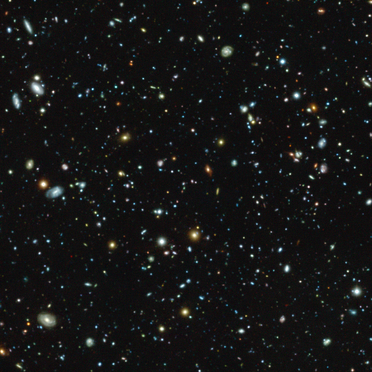
Colour image of the Hubble Ultra Deep Field region observed with the MUSE instrument on ESO’s Very Large Telescope. (Full caption in the text.) Credit: ESO/MUSE HUDF collaboration
MUSE most detailed look at galaxy field
29 November 2017. Astronomers using the MUSE instrument on ESO’s Very Large Telescope in Chile focused on the Hubble Ultra Deep Field, measuring distances and properties of 1600 very faint galaxi...
"The MUSE data enabled for the first time a systematic investigation of the motions of stars in galaxies in the early Universe. Our results show that regular stellar motions, typical of the star-forming galaxies in the present-day Universe, were already in place about 6 billion years ago,” explains Davor Krajnović, researcher at the Leibniz Institute for Astrophysics Potsdam (AIP) and one of the authors of the now published papers describing results from this survey.
The survey team observed a much-studied patch of the southern constellation of Fornax, the Hubble Ultra Deep Field (HUDF). Precise spectroscopic information was measured for ten times as many galaxies as have been detected in this field over the last decade by ground-based telescopes. The original HUDF images were pioneering deep-field observations with the NASA/ESA Hubble Space Telescope published in 2004. Now, despite the depth of the Hubble observations, MUSE has — among many other results — revealed 72 galaxies never seen before in this very tiny area of the sky. The MUSE data provides a new view of dim, very distant galaxies, seen near the beginning of the Universe. It has detected galaxies 100 times fainter than in previous surveys, adding to an already richly observed field and deepening our understanding of galaxies across the ages.
“With MUSE we discovered lots of extremely faint and small galaxies, in fact many more than were previously expected, and the combined ultraviolet radiation from these ultrafaint galaxies plays an important role in shaping the universe as we know it,” says MUSE programme scientist Lutz Wisotzki.
The survey unearthed 72 galaxies known as Lyman-alpha emitters that shine only in Lyman-alpha light, the brightest line emitted by hydrogen gas. Because MUSE disperses the light into its component colours these objects become apparent, but they remain invisible in deep direct images such as those from Hubble. Another major finding of this study was the systematic detection of luminous hydrogen halos around galaxies in the early Universe, giving astronomers a new and promising way to study how material flows in and out of early galaxies.
Many other potential applications of this dataset are explored in the series of papers, and they include studying the role of faint galaxies during cosmic reionisation (starting just 380 000 years after the Big Bang), galaxy merger rates when the Universe was young, galactic winds, star formation as well as mapping the motions of stars in the early Universe.
MUSE is an integral-field spectrograph in operation at the Very Large Telescope (VLT) of the European Southern Observatory (ESO). The overall lead of the project is at the Observatoire de Lyon (CRAL) and at ESO. MUSE covers the visible to near-infrared region and can simultaneously record thousands of spectra of entire regions on the sky and reconstruct images from this data. MUSE is one of the most successful and requested instruments at the VLT. The MUSE collaboration takes advantage of its Guaranteed Time Observing (GTO). AIP members of the MUSE-GTO team include Andreas Kelz, Josephine Kerutt, Davor Krajnović, Martin Roth, Rikke Saust, Kasper Schmidt, Ole Streicher, Matthias Steinmetz, Tanya Urrutia, Peter Weilbacher, and Lutz Wisotzki.
"Several people at AIP were involved at various levels in the now published studies. The spectroscopic survey was one of the prime reasons for building MUSE. The AIP contribution was crucial, from building the instrument, developing the data reduction pipeline, to the scientific work published in the papers,” concludes Davor Krajnović.
MUSE HUDF Special Issue in A&A:
www.aanda.org/component/toc/?task=topic&id=868
More information about MUSE:
Original press release, images, and videos by ESO:
https://www.eso.org/public/news/eso1738/
Science contacts:
Dr. Davor Krajnovic, +49 331-7499 237, dkrajnovic@aip.de
Dr. Lutz Wisotzki, +49 331-7499 532, lwisotzki@aip.de
Media contact: Katrin Albaum, +49 331-7499 803, presse@aip.de
Full image caption: Colour image of the Hubble Ultra Deep Field region observed with the MUSE instrument on ESO’s Very Large Telescope. The picture only gives a very partial view of the MUSE data, which also provide a spectrum for each pixel in the picture.
Credit: ESO/MUSE HUDF collaboration
The key areas of research at the Leibniz Institute for Astrophysics Potsdam (AIP) are cosmic magnetic fields and extragalactic astrophysics. A considerable part of the institute's efforts aim at the development of research technology in the fields of spectroscopy, robotic telescopes, and e-science. The AIP is the successor of the Berlin Observatory founded in 1700 and of the Astrophysical Observatory of Potsdam founded in 1874. The latter was the world's first observatory to emphasize explicitly the research area of astrophysics. The AIP has been a member of the Leibniz Association since 1992.
Light in the dark - Galaxies enriching MultiDark universe
20 November 2017. Scientists from the Leibniz Institute for Astrophysics Potsdam (AIP) have joined an international research team to create one of the largest sets of galaxies in a computer genera...
The Universe is filled with an immeasurable number of galaxies that themselves are accumulations of billions of stars. Understanding how these 'islands in the universe’ formed and evolved and how they are distributed throughout the Universe is central to the field of Cosmology. Luckily, we now live in an era where both ground- and space-based telescopes are being designed to study the Universe out to unprecedented distances, peering back billions of years to when the Universe was an infant. But the interpretation of these data requires theoretical models. As such, astronomers generate model universes, where galaxies are simulated, which may act as a test bed for the assessment of theories. However, such virtual universes are computationally expensive, numerically challenging, and often lack the sheer number and details of the galaxies we observe.
Now, an international team led by Prof. Alexander Knebe from the Universidad Autónoma de Madrid and Prof. Francisco Prada from the Instituto de Astrofísica de Andalucía (bringing together experts from South America, the USA, Europe, and Australia) has created one of the largest publicly available virtual universes, known as the “MultiDark-Galaxies”. What is provided to the community are galaxy catalogues based upon three distinct models that all include the physical processes relevant for galaxy formation and evolution, conforming to and reproducing specific empirical observations.
All galaxy data and also data for the simulation itself is available via the database www.cosmosim.org, hosted at the Leibniz-Institut for Astrophysics Potsdam in Germany. A selected subset is also available at www.skiesanduniverses.org, hosted at NMSU in the US and the Instituto de Astrofísica de Ansalucía CSIC in Spain. The more than 100 million virtual galaxies per model cover a cosmological volume comparable to that probed by on-going and future observational campaigns. They therefore equip researchers in the field with an unparalleled opportunity to better understand existing observations and to even make predictions for upcoming missions. More information can be found in the accompanying paper that has just been accepted by MNRAS and can be found on the arXiv: 1710.08150
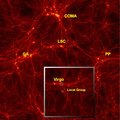
Visualization of the model galaxies. The left panel shows a slice of thickness 4.7 million light years through the whole simulation that itself has a side length of 4.8 billion light years. Each galaxy is represented by a yellow dot; the background indicates the underlying dark matter density. The right panel zooms into a smaller region. Here the dark matter haloes hosting the galaxies are visible as circles, colour-coded according to the projected density. Their sizes are scaled with their masses. Credit: Kristin Riebe/AIP
Original press release by Universidad Autónoma Madrid: https://www.uam.es/
More information about MultiDark: http://www.multidark.es
More information about CosmoSim database: https://www.cosmosim.org/
Science contact:
Noam Libeskind, +49 331-7499 641, nlibeskind@aip.de
Media contact:
Katrin Albaum, +49 331-7499 803, presse@aip.de
Database contacts:
Kristin Riebe, +49 331-7499 377, kriebe@aip.de
Anastasia Galkin +49 331-7499 685, agalkin@aip.de
Harry Enke, +49 331-7499 433, henke@aip.de
The CosmoSim database is a service by the Leibniz-Institute for Astrophysics Potsdam (AIP). It contains public data from cosmological simulations of different sizes and resolutions. The data can be accessed via a web interface and Virtual Observatory tools.
The key areas of research at the Leibniz Institute for Astrophysics Potsdam (AIP) are cosmic magnetic fields and extragalactic astrophysics. A considerable part of the institute's efforts aim at the development of research technology in the fields of spectroscopy, robotic telescopes, and e-science. The AIP is the successor of the Berlin Observatory founded in 1700 and of the Astrophysical Observatory of Potsdam founded in 1874. The latter was the world's first observatory to emphasize explicitly the research area of astrophysics. The AIP has been a member of the Leibniz Association since 1992.
Artist's Conception of SDSS-V. (Full caption in the text.) Image by Robin Dienel/Carnegie Institution for Science/SDSS
Next generation astronomical survey to map the entire sky
17 November 2017. The Alfred P. Sloan Foundation will award a $16 million grant for the next generation of the Sloan Digital Sky Survey (SDSS-V). The grant will kickstart a groundbreaking all-sky s...
The Leibniz Institute for Astrophysics Potsdam (AIP) is an associate member of SDSS with usage rights for researchers and graduate students. “AIP’s main engagement is in the APOGEE survey, which complements the RAVE survey led by AIP,” says Prof. Dr. Matthias Steinmetz, AIP’s lead scientist in the SDSS collaboration. “With these surveys we have been able to dissect the Milky Way Galaxy and thus gain new insights in its structure and formation history.”
In the tradition of previous Sloan Surveys, SDSS-V is committed to making its data publicly available in a format that is helpful to a broad range of users, from the youngest students to both amateur and professional astronomers.
The survey operates out of both Apache Point Observatory in New Mexico, home of the survey’s original 2.5-meter telescope, and Carnegie’s Las Campanas Observatory in Chile, where it uses Carnegie’s du Pont telescope. SDSS-V will make use of both optical and infrared spectroscopy, to observe not only in two hemispheres, but also at two wavelengths of light.
It will take advantage of the recently installed second APOGEE spectrograph on Carnegie’s du Pont telescope. Both it and its twin on Apache Point penetrate the dust in our Galaxy that confounds optical spectrographs to obtain high-resolution spectra for hundreds of stars at infrared wavelengths. In the optical wavelengths, the survey’s twin BOSS spectrographs can each obtain simultaneous spectra for 500 stars and quasars. What’s more, a newly envisioned pair of Integral Field Unit spectrographs can each obtain nearly 2,000 spectra contiguously across objects in the sky.
SDSS-V will consist of three projects, each mapping different components of the universe: The Milky Way Mapper, the Black Hole Mapper and the Local Volume Mapper. The first Mapper focuses on the formation of the Milky Way and its stars and planets. The second will study the formation, growth, and ultimate sizes of the supermassive black holes that lurk at the centers of galaxies. The Local Volume Mapper will create the first complete spectroscopic maps of the most-iconic nearby galaxies. “These projects will be very complementary to the 4MOST science, of which AIP is a lead,” adds Dr. Cristina Chiappini who represents the AIP in the Collaboration Council.
SDSS is managed by the astrophysical research consortium for the Participating Institutions of the SDSS Collaboration. Funding for the Sloan Digital Sky Survey IV has been provided by the Alfred P. Sloan Foundation, the U.S. Department of Energy Office of Science, and the participating institutions. The project’s fifth generation is building its consortium, but already has support from 18 institutions including the Leibniz Institute for Astrophysics Potsdam.
Original press release by the Sloan Digital Sky Survey:
www.sdss.org/press-releases/sdss5
The SDSS web site:
www.sdss.org
Science contacts:
Prof. Dr. Matthias Steinmetz, +49 331-7499 801, msteinmetz@aip.de
Dr. Cristina Chiappini, +49 331 7499-454, cristina.chiappini@aip.de
Press contact: Katrin Albaum, +49 331-7499 803, presse@aip.de
Image caption: This artist's impression shows a cutaway view of the parts of the Universe that SDSS-V will study. SDSS-V will study millions of stars to create a map of the entire Milky Way. Farther out, the survey will get the most detailed view yet of the largest nearby galaxies like Andromeda in the Northern hemisphere and the Large Magellanic Cloud in the Southern hemisphere. Even farther out, the survey will measure quasars, bright points of light powered by matter falling into giant black holes. Credit: Image by Robin Dienel/Carnegie Institution for Science/SDSS
The key areas of research at the Leibniz Institute for Astrophysics Potsdam (AIP) are cosmic magnetic fields and extragalactic astrophysics. A considerable part of the institute's efforts aim at the development of research technology in the fields of spectroscopy, robotic telescopes, and e-science. The AIP is the successor of the Berlin Observatory founded in 1700 and of the Astrophysical Observatory of Potsdam founded in 1874. The latter was the world's first observatory to explicitly emphasize the research area of astrophysics. The AIP has been a member of the Leibniz Association since 1992.
Award for equal opportunity
1 November 2017. The Leibniz Institute for Astrophysics Potsdam (AIP) has received the „TOTAL E-QUALITY“ award for the years 2017 to 2019. It is presented to organizations from the private sect...
„The Leibniz Institute for Astrophysics has well established structures concerning gender equality,“ announced the jury in its award statement. „It has made significant progress towards increasing the proportion of women in leading positions in the past years.“ The committee was also especially pleased by the above average proportion of women who obtain academic or doctoral degrees, and by the commitment to promoting a healthy balance between work and family life. The institute’s internal development objectives include both medium- and long-term goals, which are defined according to relevant personnel and gender equality issues. For 2020, the AIP has set new targets for its efforts regarding gender equality with the so-called cascade model. An active recruitment that is committed to gender equality will make it possible for these quotas to be achieved.
Currently, women hold 19 percent of leading positions at AIP; 28 percent of all employees are female. To promote the compatibility of work and family life, the AIP allows all employees flexible working hours, a policy which has been in place for the past several years. “After our success in promoting workplace equality and a healthy work-life balance, the AIP will be made even more attractive by emphasizing a focus on equal opportunity”, says Matthias Winker, Administrative Chairman of AIP. “The topic of equality takes the needs of the employees at an international institute such as the AIP into consideration, and it has also links to diversity. Our recent success with two separate certifications has demonstrated the high standards of the AIP for achieving equality. Continuing in this direction, I see a lot of opportunities for the future”, continued Winker.
The jury specifically appreciates the ambitious goals which the AIP has set for future recruitments as well as the steps that the institute has planned for other initiatives such as personnel marketing, institutionalization, and care. „We are looking forward to receiving the next application in 2020, which will hopefully demonstrate further progress and sustainability towards a workplace with equal opportunity, so that the AIP can retain this award for another three years.“
Website of the TOTAL E-QUALITY award: www.total-e-quality.de/en
Contact: Matthias Winker, Administrative Chairman, +49 331-7499 811
Press contact: Katrin Albaum, +49 331-7499 803, presse@aip.de
Matthias Winker, Administrative Chairman of AIP, with the "TOTAL E-QUALITY" certificate. Image by: TOTAL E-QUALITY Deutschland e. V.
The key areas of research at the Leibniz Institute for Astrophysics Potsdam (AIP) are cosmic magnetic fields and extragalactic astrophysics. A considerable part of the institute's efforts aim at the development of research technology in the fields of spectroscopy, robotic telescopes, and e-science. The AIP is the successor of the Berlin Observatory founded in 1700 and of the Astrophysical Observatory of Potsdam founded in 1874. The latter was the world's first observatory to explicitly emphasize the research area of astrophysics. The AIP has been a member of the Leibniz Association since 1992.