Press releases
Measuring the Universe More Accurately Than Ever Before
6 March 2013. New results pin down the distance to the galaxy next door. - After nearly a decade of careful observations an international team of astronomers, among them Jesper Storm, scientist at the Leibniz-Institute for Astophysics Potsdam (AIP), has measured the distance to our neighbouring galaxy, the Large Magellanic Cloud, more accurately than ever before. This new measurement also improves our knowledge of the rate of expansion of the Universe — the Hubble Constant — and is a crucial step towards understanding the nature of the mysterious dark energy that is causing the expansion to accelerate. The team used telescopes at ESO’s La Silla Observatory in Chile as well as others around the globe. These results appear in the 7 March 2013 issue of the journal Nature.
Leibniz Graduate School for »Quantitative Spectroscopy in Astrophysics« starts
19 February 2013. The Leibniz Institute for Astrophysics Potsdam (AIP) and the University of Potsdam jointly offer eight PhD stipends within the Graduate School focussing on »quantitative Spectroscopy in Astrophysics«.
Where are all the dwarfs?
1 February 2013. Astronomers of the international CLUES collaboration have identified “Cosmic Web Stripping” as a new way of explaining the famous missing dwarf problem: the lack of observed dwarf galaxies compared with that predicted by the theory of Cold Dark Matter and Dark Energy.
Life possible on extrasolar moons
10 January 2013. In their search for habitable worlds, astronomers have started to consider exomoons, or those likely orbiting planets outside the solar system. In a new study, a pair of researchers has found that exomoons are just as likely to support life as exoplanets.
From Sunspots to Starspots
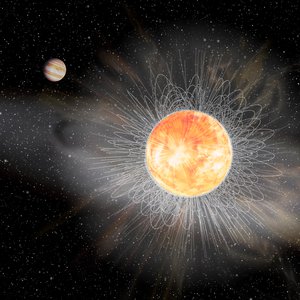
6 December 2012. For the first time, astronomers have detected the magnetic field of a starspot
Dr Andreas Schulze awarded with Michelson prize
5 November 2012. The University of Potsdam awards Dr Andreas Schulze with this year's Michelson prize. Schulze worked on his thesis about "Demographics of Supermassive Black Holes" at the Leibniz Institute for Astrophysics Potsdam (AIP).
New administrative chairman of AIP: Dr. Ulrich Müller
1 November 2012. Dr Ulrich Müller is the new administrative chairman of AIP.
CALIFA: The local extragalactic universe unveiled
1 November 2012. The Calar Alto Legacy Integral Field Area survey (CALIFA survey) announces today its first public release of data, offering an unprecedentedly detailed view of 100 galaxies in the local universe with ample opportunities for scientific study.
Wempe Award for Thomas R. Ayres
4 October 2012. The 2012 Johann Wempe Award is awarded to Prof. Dr. Thomas R. Ayres from the Center for Astrophysics and Space Astronomy of the University of Colorado, Boulder, U.S.A. for his contributions to ultraviolet stellar spectroscopy and his detection of COmospheres.
Astronomers see galaxy-altering quasars ignite
27 September 2012. Analysing data from NASA's Spitzer and Hubble Space Telescopes an international team of astronomers around Tanya Urrutia from AIP has caught sight of luminous quasars igniting after galaxies collide. Quasars are bright, energetic regions around giant, active black holes in galactic centers.
Biermann Award goes to Cecilia Scannapieco
25 September 2012. Cecilia Scannapieco, currently working at the Leibniz Institute for Astrophysics Potsdam (AIP), is awarded with the Ludwig Biermann Award of the Astronomische Gesellschaft (AG). The award ceremony takes place in Hamburg on September 25, 2012.
Using artificial intelligence to chart the universe
24 September 2012. Astronomers in Germany have developed an artificial intelligence algorithm to help them chart and explain the structure and dynamics of the universe around us. The team, led by Francisco Kitaura of the Leibniz Institute for Astrophysics in Potsdam, report their results in the journal Monthly Notices of the Royal Astronomical Society.
Minor planet renamed after scientist from Potsdam
13 September 2012. The Committee on Small Body Nomenclature of the International Astronomical Union (IAU) has decided that the main-belt Asteroid 278513 is from now on called "Schwope".
Karl Schwarzschild Fellowship 2012 goes to Dr. Federico Spada
3 September 2012. Dr. Federico Spada is awarded with the Karl Schwarzschild Fellowship 2012. Spada attended the University of Catania, Italy, and got his Master in Physics 2006 for his dissertation about "Galactic dynamo and radio emission polarisation" before receiving 2010 his PhD for his thesis "Rotational history of solar-like stars and angular momentum transport in radiative interiors". He then left for the Institute for Biospheric Studies at Yale University, where he worked with Sabatino Sofia at the Astronomy Departement.
Technology Transfer in Spectroscopy (GERMAN)
9 July 2012. Start-up management seminar: final results presentation
Magnetic fields slow down stars
12 June 2012. Scientists have proved the existence of a magnetic effect that could explain why solar-like stars spin very slowly at the end of their lifetime.
Publication Award for Meetu Verma
9 May 2012. Meetu Verma is honored with the Publication Award for young scientists awarded on 10 May 2012 by the 16th Leibniz Kolleg Potsdam. She earned it for three publications about velocity fields on the surface of the sun, which were published in the referred journals Astronomy & Astrophysics and Astronomical Notes.
When Dark Energy turned on
30 March 2012. The Sloan Digital Sky Survey (SDSS-III) today announced the most accurate measurements yet of the distances to galaxies in the faraway universe, giving an unprecedented look at the time when the universe first began to accelerate. From different perspectives six publications, which have been published online now, address the question of “Dark Energy“, the unknown force that drives our Universe apart.
Gaseous ring around young star raises questions
18 January 2012. Astronomers have detected a mysterious ring of carbon monoxide gas around the young star V1052 Cen, which is about 700 light years away in the southern constellation Centaurus. The ring is part of the star’s planet-forming disk, and it’s as far from V1052 Cen as Earth is from the sun. Discovered with the European Southern Observatory's Very Large Telescope, its edges are uniquely crisp.