This website uses cookies for better user experience. Learn more in our
Data protection statement
and the
Cookies page, where you can also enable/disable individual cookies and services.
By continuing to use this site, you consent to our policies.
The Leibniz Institute for Astrophysics Potsdam (AIP) is dedicated to astrophysical questions ranging from the exploration of our Sun to the evolution of the cosmos. It focuses on the study of stellar, solar and exoplanetary physics, extragalactic astrophysics and the development of research technologies in the fields of spectroscopy, robotic telescopes and E-science.
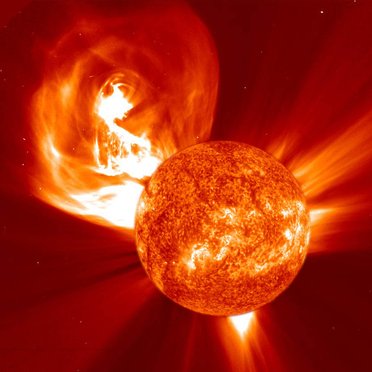
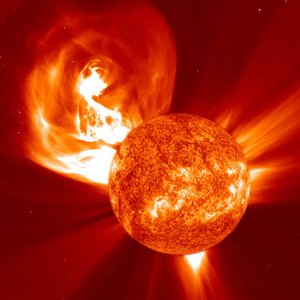
An international team of astrophysicists and plasma physicists has provided the first experimental evidence that strong magnetic fields surrounding active stars can completely suppress coronal mass ejections. This gives clues to understanding why massive stellar eruptions are rarely observed on stars other than the Sun.
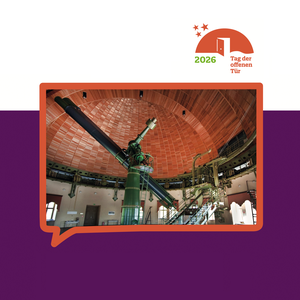
On Saturday the 26th of September 2026, the Telegrafenberg will welcome visitors for an open day from 12 pm to 5 pm. The Alfred Wegener Institute (AWI), Potsdam Institute for Climate Impact Research (PIK), GFZ Helmholtz Centre for Geosciences and the Leibniz Institute for Astrophysics Potsdam (AIP) invite the public to get a close-up look at the ‘Albert Einstein’ Science Park and the top-level research carried out there.
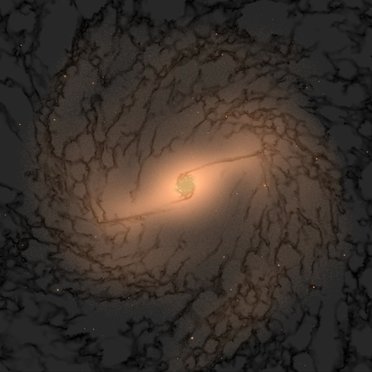
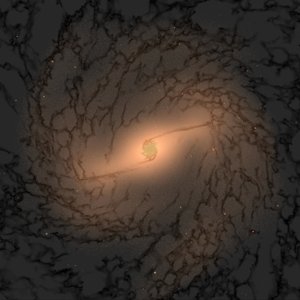
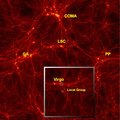
Using a state-of-the-art galaxy simulation, a team led by scientists from the Leibniz Institute for Astrophysics Potsdam (AIP) gained new insights into the processes shaping galactic centres across the Universe and the formation history of the Milky Way, bridging theory and observations.
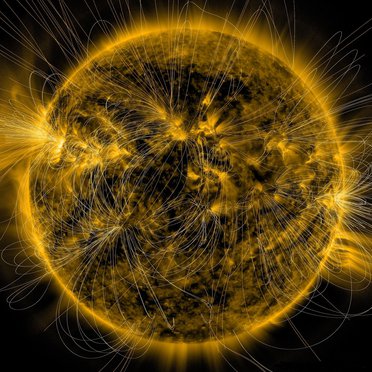
Cosmic events are determined by two natural forces: gravity and magnetic fields. The magnetic field research at the AIP is mainly focused on magnetohydrodynamic (MHD) simulations, the magnetically induced activities on the Sun and the stars, solar coronaphysics as well as space weather in our solar system and on planets around other stars.
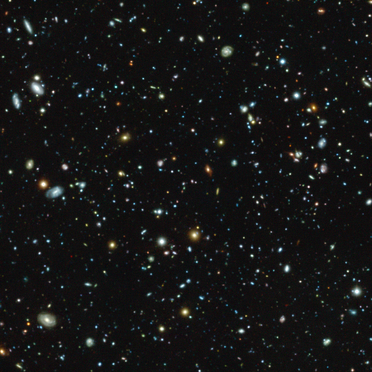
Galaxies are fundamental cosmic building blocks. At the largest scales, they serve as markers to study the distribution of matter in the universe - active galaxies and quasars are particularly important because of their intrinsic brightness. Nearby objects can be spatially resolved and consist of populations with very different patterns of motion, star formation histories and chemical abundances.
An international team of astrophysicists and plasma physicists has provided the first experimental evidence that strong magnetic fields surrounding active stars can completely suppress coronal mass ejections. This gives clues to understanding why massive stellar eruptions are rarely observed on stars other than the Sun.
On Saturday the 26th of September 2026, the Telegrafenberg will welcome visitors for an open day from 12 pm to 5 pm. The Alfred Wegener Institute (AWI), Potsdam Institute for Climate Impact Research (PIK), GFZ Helmholtz Centre for Geosciences and the Leibniz Institute for Astrophysics Potsdam (AIP) invite the public to get a close-up look at the ‘Albert Einstein’ Science Park and the top-level research carried out there.
Using a state-of-the-art galaxy simulation, a team led by scientists from the Leibniz Institute for Astrophysics Potsdam (AIP) gained new insights into the processes shaping galactic centres across the Universe and the formation history of the Milky Way, bridging theory and observations.
Supermassive Black Hole Assembly from Heavy Seeds with Dynamical Friction in the BRAHMA Simulations: Implications for JWST, LISA, and the Local Universe
Bhowmick, A. K., ... Weinberger, R., ...
The Astrophysical Journal, 1008, 1, 30 – Published September 2026
The SRG/eROSITA All-Sky Survey DR2: Cumulative X-ray catalogues from the first three surveys and multi-wavelength counterparts in the western Galactic hemisphere
Ramos-Ceja, M. E., Lamer, G., ... Schwope, A., ... Tubín-Arenas, D., Traulsen, I., ... Brink, J., ... Ilic, N., ... Krumpe, M., ... Kurpas, J., ... Ok, S., ... Poppenhaeger, K., Pradeep, K. G., ... Sheth, S., ...
Astronomy and Astrophysics, 712, A171 – Published August 2026
Speaker: Juan Sebastián Castellanos-Durán (MPS, Germany) (Max Planck Institute for Solar System Research (MPS, Göttingen, Germany)) Title: On the extremes of solar spectropolarimetric data: Superstrong magnetic fields and extreme limb observations
The AIP invites to a public observation evening in the Great Refractor at the Telegrafenberg in Potsdam. Prior registration required, see Observation Evenings.