STELLA

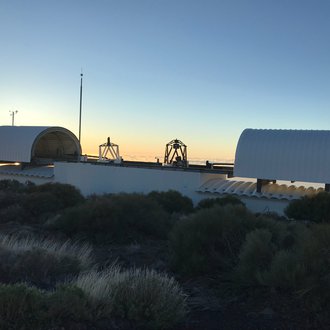
STELLA, short for STELLar Activity are two fully robotic, 1.2m telescope at Izana Observatory located in Tenerife, Spain. They uniquely combine a high-resolution spectrograph, SES and a wide-field imager, WiFSIP. STELLA is a long-term project for observing and monitoring activity tracers on cool stars with two robotic telescopes.
It was inaugurated in 2006 and is in fully robotic operation ever since. It dwarfs commonly operated telescopes not only in running costs: Over the years, the STELLA team was successful in lowering the technical downtime of the telescopes to a mere 2%. Also the shutter-open times are impressive: 87.5% for SES and 67.9% for WiFSIP. To reach such a performance, it is necessary to do tasks not only sequentially, but, whenever possible, in parallel, merging individual tasks only when required. As an example, the telescopes already perform slewing and acquiring of the next target, while the previous exposure is still read out. Scheduling can be tuned to favor targets in the vicinity of the current pointing, minimizing slewing overhead. At the core of it, a software package, general enough to allow the operation of any (optical) telescope termed STELLA Control System (SCS) resides. It features amongst others an XML-based meta-language allowing fresh observing templates to be devised and injected into the running system, if new observing strategies are needed. Scheduling is based on a dispatcher schema, a greedy optimizing heuristic, which allows pooling of many possible observations (up to a few hundred currently, but at times passing the one-thousand barrier) and letting the algorithm decided, which observation currently to execute.
STELLA’s Echelle Spectrograph SES will get two cousins in the next years. The first one is already planned for arrival in 2021, the second one for 2023. STELLA-II will then feed three spectrographs simultaneously, all with a spectral resolution of around 55,000.
STELLA is a project of the Leibniz-Institut für Astrophysik Potsdam (AIP) in collaboration with the Instituto de Astrofísica de Canarias (IAC).
PI of STELLA is K. Strassmeier.
M. Weber is responsible for all hardware issues of both telescopes and instruments and the point of contact for the SES data reduction pipeline.
T. Granzer is responsible for software issues and the WiFSIP data reduction pipeline.
Partners:
Involved AIP (research) groups:
Research Data Infrastructure, Astronomical Spectroscopic Instrumentation, Stellar, Solar and Exoplanetary Physics, Stellar Physics and Exoplanets, Technical Section