This website uses cookies for better user experience. Learn more in our
Data protection statement
and the
Cookies page, where you can also enable/disable individual cookies and services.
By continuing to use this site, you consent to our policies.
The Leibniz Institute for Astrophysics Potsdam (AIP) is dedicated to astrophysical questions ranging from the study of our Sun to the evolution of the cosmos. The research focuses on the area of stars, the Sun and exoplanets, galactic and extragalactic astrophysics, and cosmology. A significant share of the work involves research and development in the area of astrophysical spectroscopy, astrophotonics and the research data infrastructure.
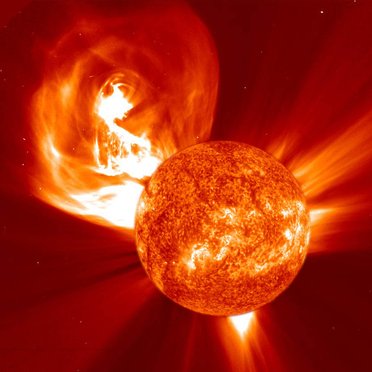
An international team of astrophysicists and plasma physicists has provided the first experimental evidence that strong magnetic fields surrounding active stars can completely suppress coronal mass ejections. This gives clues to understanding why massive stellar eruptions are rarely observed on stars other than the Sun.
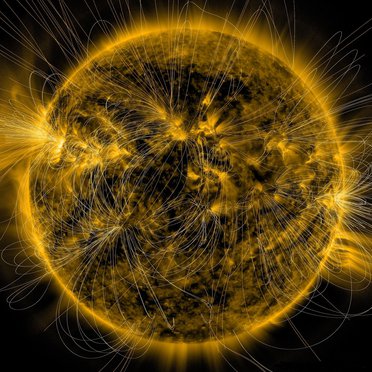
Cosmic events are determined by two natural forces: gravity and magnetic fields. The magnetic field research at the AIP is mainly focused on magnetohydrodynamic (MHD) simulations, the magnetically induced activities on the Sun and the stars, solar coronaphysics as well as space weather in our solar system and on planets around other stars.
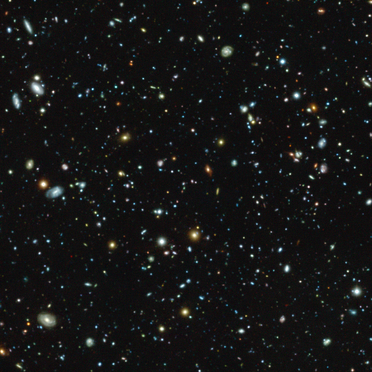
Galaxies are fundamental cosmic building blocks. At the largest scales, they serve as markers to study the distribution of matter in the universe - active galaxies and quasars are particularly important because of their intrinsic brightness. Nearby objects can be spatially resolved and consist of populations with very different patterns of motion, star formation histories and chemical abundances.
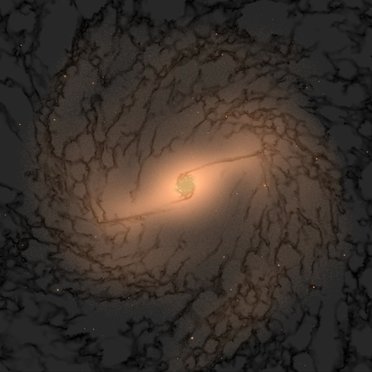
Using a state-of-the-art galaxy simulation, a team led by scientists from the Leibniz Institute for Astrophysics Potsdam (AIP) gained new insights into the processes shaping galactic centres across the Universe and the formation history of the Milky Way, bridging theory and observations.
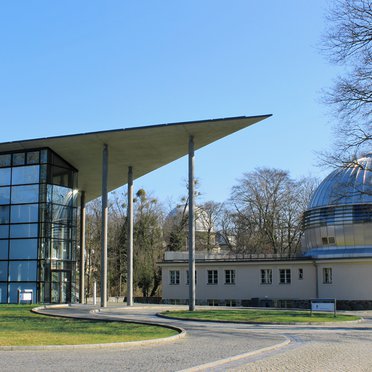
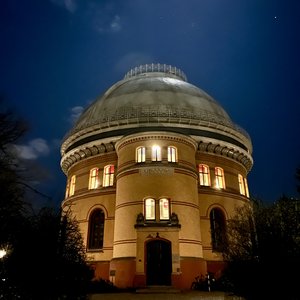
On the Babelsberg campus of the Leibniz Institute for Astrophysics Potsdam (AIP), you can take a journey through the history of astronomy from the beginning of the last century in just a few steps. In 1913, today's Humboldthaus became the new home of the Berlin Observatory, which moved from the ever-growing city to the then undisturbed Babelsberg night sky.
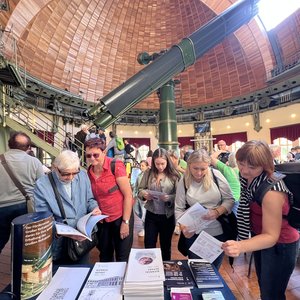
As the days grow shorter and the nights longer, the AIP is once again inviting the public to the Babelsberg Star Nights. From October 2026 to March 2027, the AIP will open its doors on six evenings to everyone interested in astronomy.
During the winter months, we offer again observation evenings at the Great Refractor on Telegrafenberg in Potsdam. Due to the high demand and to avoid long waiting times, advance booking is required. Admission is free.
The four research institutes at Telegrafenberg had organised an open day on 26 September. This past Saturday’s exciting programme offered a fascinating journey of discovery – from the Earth’s interior to the infinity of the universe, from fundamental insights to practical applications.
The AIP invites to a public observation evening in the Great Refractor at the Telegrafenberg in Potsdam. Prior registration required, see Observation Evenings.
The AIP invites to a public observation evening in the Great Refractor at the Telegrafenberg in Potsdam. Prior registration required, see Observation Evenings.