Research Group on Cosmic Jets Gets Extended
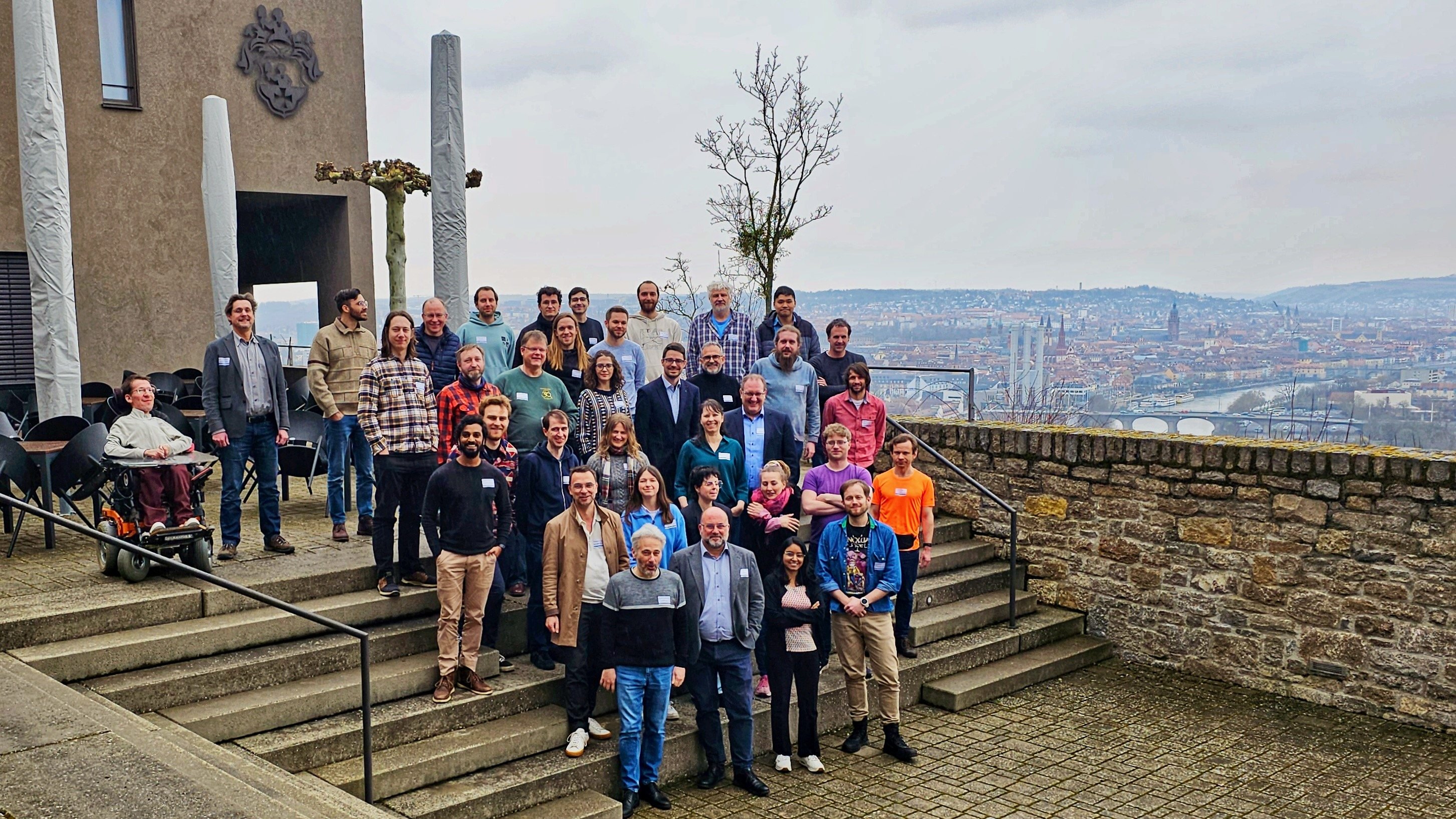
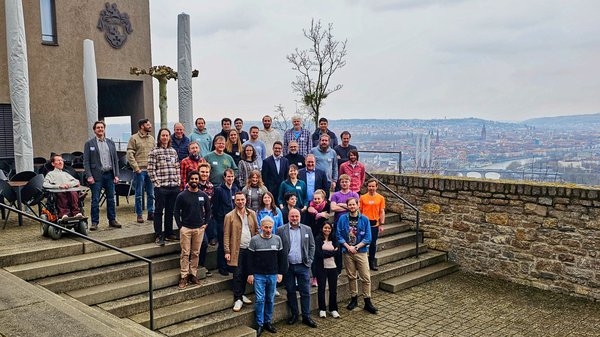
Group picture of the research group “Relativistic Jets in Active Galaxies”
Credit: Shetgaonkar/FOR5195The research group "Relativistic Jets in Active Galaxies", in which the Leibniz Institute for Astrophysics Potsdam is also involved, has been investigating the powerful plasma beams emanating from supermassive black holes since 2021. Now the DFG has extended its funding.
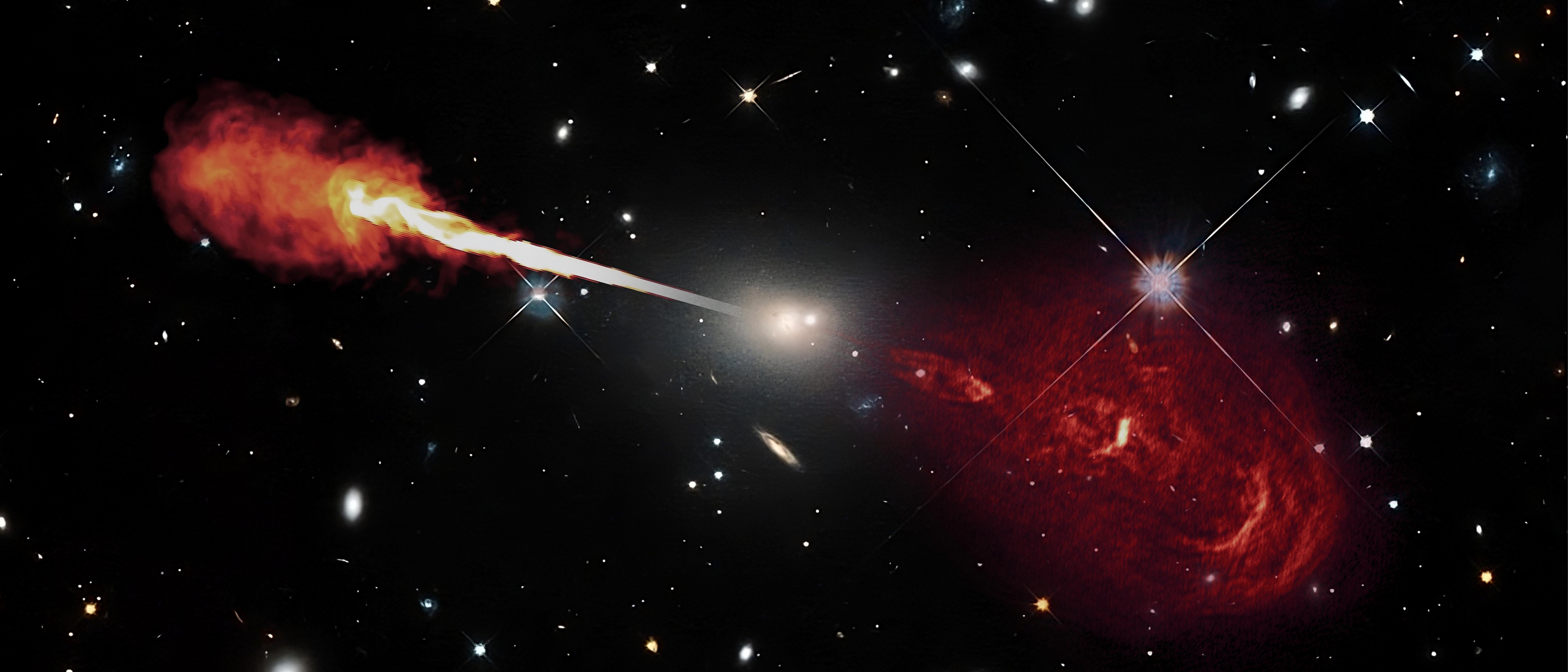
At the center of almost every large galaxy lies a supermassive black hole – an object with mass millions to billions of times that of our sun. While these cosmic giants are known for their unimaginable gravitational pull, under certain conditions they can not only devour matter, but also hurl it back into space in the form of powerful plasma beams.
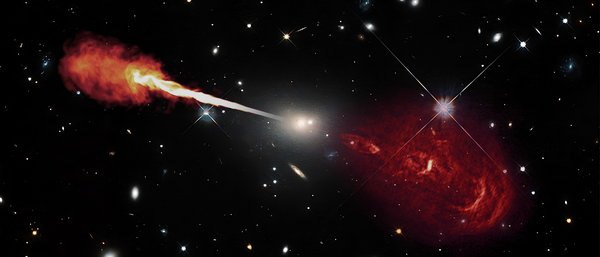
Known as “relativistic jets,” these phenomena are collimated streams of high-energy particles that shoot out of the immediate vicinity of the black hole at nearly the speed of light. They radiate across the entire electromagnetic spectrum and can reach distances far beyond their home galaxy. “Research of these jets is of fundamental importance because it touches on profound questions of astrophysics and cosmology,” says Prof. Dr. Matthias Kadler, University of Würzburg and spokesperson for the research group “Relativistic Jets in Active Galaxies” funded by the German Research Foundation (DFG).
The research network brings together numerous leading research institutions from Germany and partner groups across Europe in this field, with the University of Würzburg serving as the coordinating institution. This includes researchers at the Leibniz Institute for Astrophysics Potsdam (AIP), who are investigating the exciting question of how these jets influence the growth of galaxies and galaxy clusters.
For the past four years, the network has been working to deepen knowledge about these jets – with success: the DFG has now extended the research group's work for another four years. It is providing about 4.75 million euros for this purpose. “The extension is a sign of recognition for the outstanding scientific work of our research group and underlines the special significance of the research topic and the cosmological implications of feedback by accreting supermassive black holes in galaxies,” says Prof. Dr. Christoph Pfrommer, member of the research group and Section Head of Cosmology and High Energy Astrophysics at the AIP.
Over the past four years, the members of the research unit have made significant progress in answering numerous questions about the nature of jets. For example, they were involved in the groundbreaking observations of the Event Horizon Telescope (EHT). These led to the world's first glimpses of supermassive black holes and the associated “launch pads” of cosmic jets.
However, the group's work is not yet complete – quite the contrary: “Our successes to date have paved the way for new and exciting research – for example, into how jets trigger turbulence and associated heating processes in galaxy clusters, and how these mechanisms relate to the latest radio and X-ray observations,” says Christoph Pfrommer. He is therefore confident that the group will continue to discover new and exciting details about jets in the coming years.
The participating scientists are pursuing three key objectives:
- Understanding the origin of jets: How exactly do these jets form directly at the edge of black holes, and what gives them their enormous energy and precise alignment?
- Analyzing jet composition and radiation: What are these jets made of, and what physical processes cause them to shine so brightly – from radio waves to high-energy gamma and particle radiation?
- Assessing the influence of jets on the universe: How do these plasma beams shape the development of entire galaxies and galaxy clusters, for example by regulating star formation and heating up their surroundings?
For the coming funding period, the team has set itself new priorities that aim to push the boundaries of what is currently known:
- Neutrino astronomy: The researchers want to investigate the connection between jets and high-energy neutrinos.
- Cosmological evolution: A particular focus is on the role of jets in the early universe. Due to their extreme brightness, jets serve as unique beacons for tracing the evolution of galaxies and black holes over billions of years.
- New and improved telescopes: The research group is actively involved in the development and improvement of state-of-the-art telescopes such as the Bavarian Wetterstein Millimeter Telescope, the European research infrastructures Low Frequency Array (LOFAR) and Cherenkov Telescope Array (CTA), and the worldwide Global Millimeter VLBI Array (GMVA).
A Germany-wide Network of Experts
The research unit brings together expertise from various fields of astrophysics – from theoretical modeling and computer simulations to observations with the world's best telescopes. The research group is coordinated by University of Würzburg. Together with a working group from the University of Hamburg, the group at AIP is investigating how jets control the development of entire galaxies and galaxy clusters – for example, by controlling star formation and the heating processes in their environment.
Other institutions funded by the network include the Universities of Erlangen-Nuremberg, and Heidelberg, the Max Planck Institutes for Radio Astronomy in Bonn and Astronomy in Heidelberg, and the German Electron Synchrotron (DESY) in Zeuthen. Internationally, the Open University in the UK, IA-FORTH in Greece, and the University of Valencia are closely involved in the research.
DFG Research Groups
DFG Research Groups are a key instrument of German research funding. They enable leading researchers to work together on complex scientific tasks. The funding is intended to help provide the necessary personnel and material resources for close cooperation in the medium term.
Further information
Group picture of the research group “Relativistic Jets in Active Galaxies”
Credit: Shetgaonkar/FOR5195The research group "Relativistic Jets in Active Galaxies", in which the Leibniz Institute for Astrophysics Potsdam is also involved, has been investigating the powerful plasma beams emanating from supermassive black holes since 2021. Now the DFG has extended its funding.
At the center of almost every large galaxy lies a supermassive black hole – an object with mass millions to billions of times that of our sun. While these cosmic giants are known for their unimaginable gravitational pull, under certain conditions they can not only devour matter, but also hurl it back into space in the form of powerful plasma beams.
Known as “relativistic jets,” these phenomena are collimated streams of high-energy particles that shoot out of the immediate vicinity of the black hole at nearly the speed of light. They radiate across the entire electromagnetic spectrum and can reach distances far beyond their home galaxy. “Research of these jets is of fundamental importance because it touches on profound questions of astrophysics and cosmology,” says Prof. Dr. Matthias Kadler, University of Würzburg and spokesperson for the research group “Relativistic Jets in Active Galaxies” funded by the German Research Foundation (DFG).
The research network brings together numerous leading research institutions from Germany and partner groups across Europe in this field, with the University of Würzburg serving as the coordinating institution. This includes researchers at the Leibniz Institute for Astrophysics Potsdam (AIP), who are investigating the exciting question of how these jets influence the growth of galaxies and galaxy clusters.
For the past four years, the network has been working to deepen knowledge about these jets – with success: the DFG has now extended the research group's work for another four years. It is providing about 4.75 million euros for this purpose. “The extension is a sign of recognition for the outstanding scientific work of our research group and underlines the special significance of the research topic and the cosmological implications of feedback by accreting supermassive black holes in galaxies,” says Prof. Dr. Christoph Pfrommer, member of the research group and Section Head of Cosmology and High Energy Astrophysics at the AIP.
Over the past four years, the members of the research unit have made significant progress in answering numerous questions about the nature of jets. For example, they were involved in the groundbreaking observations of the Event Horizon Telescope (EHT). These led to the world's first glimpses of supermassive black holes and the associated “launch pads” of cosmic jets.
However, the group's work is not yet complete – quite the contrary: “Our successes to date have paved the way for new and exciting research – for example, into how jets trigger turbulence and associated heating processes in galaxy clusters, and how these mechanisms relate to the latest radio and X-ray observations,” says Christoph Pfrommer. He is therefore confident that the group will continue to discover new and exciting details about jets in the coming years.
The participating scientists are pursuing three key objectives:
- Understanding the origin of jets: How exactly do these jets form directly at the edge of black holes, and what gives them their enormous energy and precise alignment?
- Analyzing jet composition and radiation: What are these jets made of, and what physical processes cause them to shine so brightly – from radio waves to high-energy gamma and particle radiation?
- Assessing the influence of jets on the universe: How do these plasma beams shape the development of entire galaxies and galaxy clusters, for example by regulating star formation and heating up their surroundings?
For the coming funding period, the team has set itself new priorities that aim to push the boundaries of what is currently known:
- Neutrino astronomy: The researchers want to investigate the connection between jets and high-energy neutrinos.
- Cosmological evolution: A particular focus is on the role of jets in the early universe. Due to their extreme brightness, jets serve as unique beacons for tracing the evolution of galaxies and black holes over billions of years.
- New and improved telescopes: The research group is actively involved in the development and improvement of state-of-the-art telescopes such as the Bavarian Wetterstein Millimeter Telescope, the European research infrastructures Low Frequency Array (LOFAR) and Cherenkov Telescope Array (CTA), and the worldwide Global Millimeter VLBI Array (GMVA).
A Germany-wide Network of Experts
The research unit brings together expertise from various fields of astrophysics – from theoretical modeling and computer simulations to observations with the world's best telescopes. The research group is coordinated by University of Würzburg. Together with a working group from the University of Hamburg, the group at AIP is investigating how jets control the development of entire galaxies and galaxy clusters – for example, by controlling star formation and the heating processes in their environment.
Other institutions funded by the network include the Universities of Erlangen-Nuremberg, and Heidelberg, the Max Planck Institutes for Radio Astronomy in Bonn and Astronomy in Heidelberg, and the German Electron Synchrotron (DESY) in Zeuthen. Internationally, the Open University in the UK, IA-FORTH in Greece, and the University of Valencia are closely involved in the research.
DFG Research Groups
DFG Research Groups are a key instrument of German research funding. They enable leading researchers to work together on complex scientific tasks. The funding is intended to help provide the necessary personnel and material resources for close cooperation in the medium term.
Further information
Images
Group picture of the research group “Relativistic Jets in Active Galaxies”
Big screen size [1000 x 562, 170 KB]
Original size [2906 x 1635, 990 KB]
HercA, FOR5195
Big screen size [1000 x 428, 40 KB]
Original size [7000 x 3000, 800 KB]