Full house at the open day on Telegrafenberg
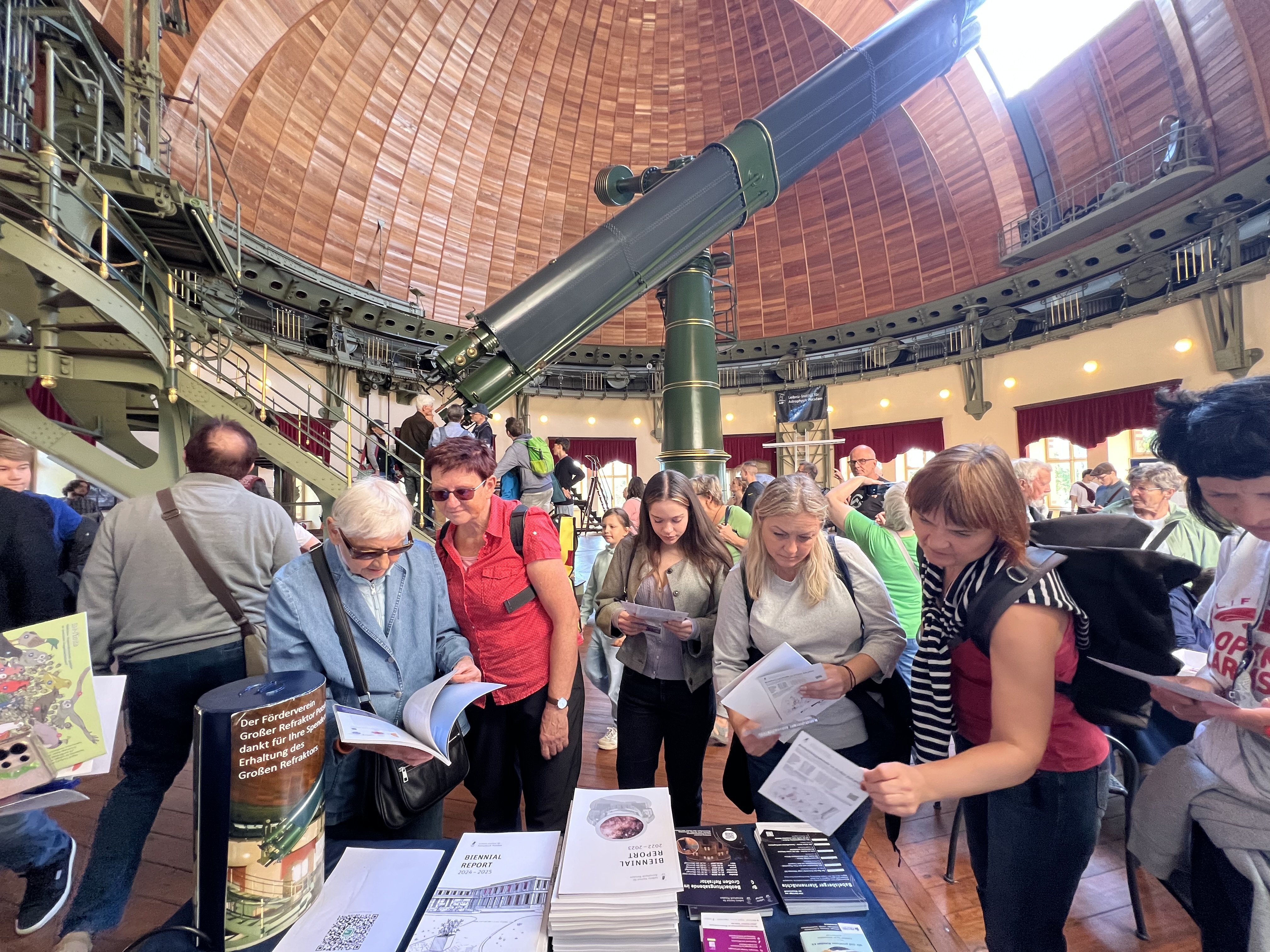
About 3500 visitors came to the open day on Telegrafenberg
Credit: AIPThe four research institutes at Telegrafenberg had organised an open day on 26 September. This past Saturday’s exciting programme offered a fascinating journey of discovery – from the Earth’s interior to the infinity of the universe, from fundamental insights to practical applications.
Around 3,500 interested people, including many families and children, came to the Potsdam Telegrafenberg on foot or by shuttle bus for the first Open Day of the four research institutes of the “Albert Einstein” Science Park.
The GFZ Helmholtz Centre for Geosciences, the Alfred Wegener Institute, Helmholtz Centre for Polar and Marine Research (AWI), the Potsdam Institute for Climate Impact Research (PIK) and the Leibniz Institute for Astrophysics Potsdam (AIP) opened their doors to everyone for the first time independently of the Long Night of Sciences and as a complement to the Potsdam Day of Science. They offered unique insights into current cutting-edge research on a wide range of topics related to the Earth – from its dynamic depths and heights, with the oceans and polar regions, through climate change and its consequences, to near and distant outer space.
The programme included around 70 contributions and stations – from presentation and information stands, experiment stations and laboratory tours to lectures and guided tours of the historic science campus.
The visitors were amazed, asked questions, discussed, played and used the opportunity to get information and to do experiments themselves. Many people from Potsdam visited the Telegrafenberg for the first time, while others were happy to be there again. Some visitors had even travelled from further away – from the wider Berlin-Brandenburg area and even from Hamburg. Some celebrated a child’s birthday with the research rally for children, whose successful completion was rewarded with small prizes. Visitors could also get insights into the different career paths offered by the research institutions as important employers in the region, whether in administration, technical fields or science.
Prof. Dr. Susanne Buiter, Scientific Director of the GFZ Helmholtz Centre for Geosciences, concludes:
“We are happy that so many visitors came to the Telegrafenberg to discover ‘science made in Potsdam’, to become active themselves and to talk with us. The exchange with all parts of society is an essential part of our work. Our message is therefore clear: research does not take place ‘up there on the mountain’, but with its questions, topics and solutions, it is close to people’s everyday lives and is an important basis for the further development of our society and the preservation of a planet suitable for life. With events like this, we offer valuable insights into the processes behind scientific knowledge. They show how diverse the people, their activities and their professions are who contribute to this.”
Dr. Bettina Hörstrup, Administrative Director of the Potsdam Institute for Climate Impact Research (PIK), explains:
“The Potsdam Institute carries our city in its name – and despite all our international activities, our local and regional connection is very important to us. We were very happy to now experience how lively this relationship is. On the Open Day, our researchers reported that the rooms were completely full during the lectures and interactive activities, and that there were many, sometimes long and intensive, conversations at the information stands. We would like to thank the many curious people from Potsdam, Brandenburg and Berlin for this unforgettable day.”
Prof. Dr. Bernhard Diekmann, Head of the Potsdam Research Unit of the Alfred Wegener Institute, Helmholtz Centre for Polar and Marine Research (AWI), says:
“I am very happy that we were able to welcome 3,500 visitors to our ‘Open Day’ here on the Telegrafenberg. With experiments, games, current information from our research and numerous lectures, we were able to present not only the whole range of our scientific work. Many interesting conversations also developed with visitors, both young and old – when trying on polar suits, at the permafrost installations or at the measuring stations that had been set up. Conversations like these are especially important in the challenging times we are living in. We are all currently experiencing major changes in our world. Explaining these changes through well-founded scientific knowledge is more important than ever. Having direct conversations with our visitors was a lot of fun. We are already looking forward to the next time.”
Wolfram Rosenbach, Administrative Director of the Leibniz Institute for Astrophysics Potsdam (AIP), concludes:
“It is nice to see how positively the interdisciplinary cooperation between four different institutes on the Telegrafenberg has been received. The Open Day on the Telegrafenberg brings together the perspectives of different research topics – together, they create a programme that shows the full diversity of this science location. I was especially pleased to see how much curiosity the visitors showed towards research in Potsdam. The direct exchange, the many questions and the enthusiasm made the day something special for us.”
Images
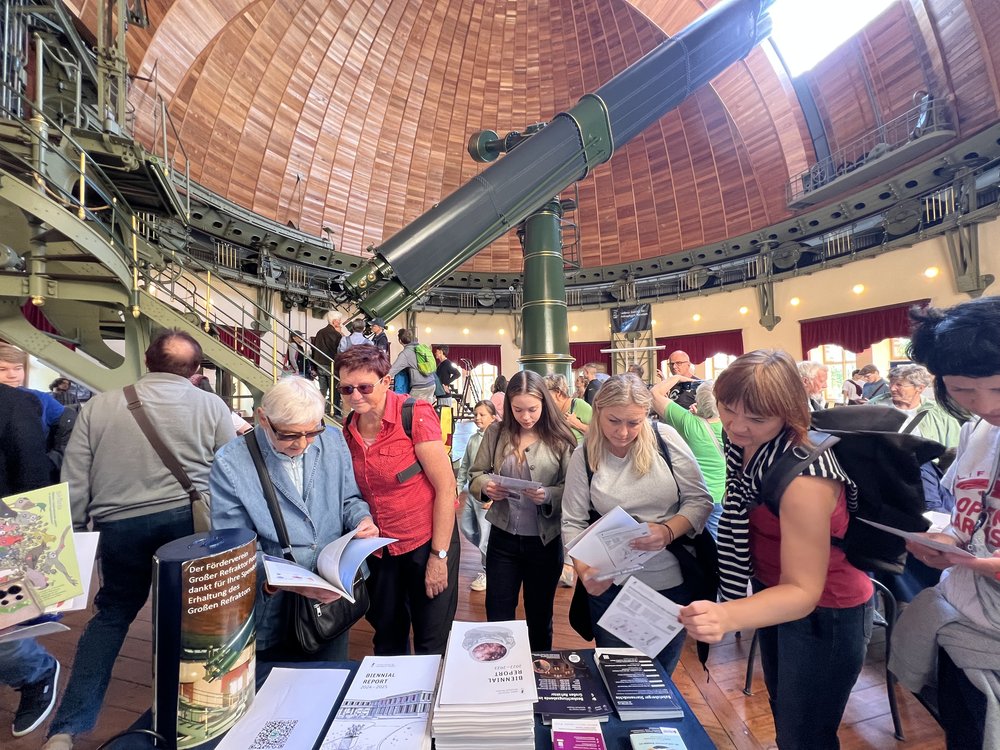
About 3500 visitors came to the open day on Telegrafenberg
Big screen size [1000 x 750, 210 KB]
Original size [4032 x 3024, 2.2 MB]
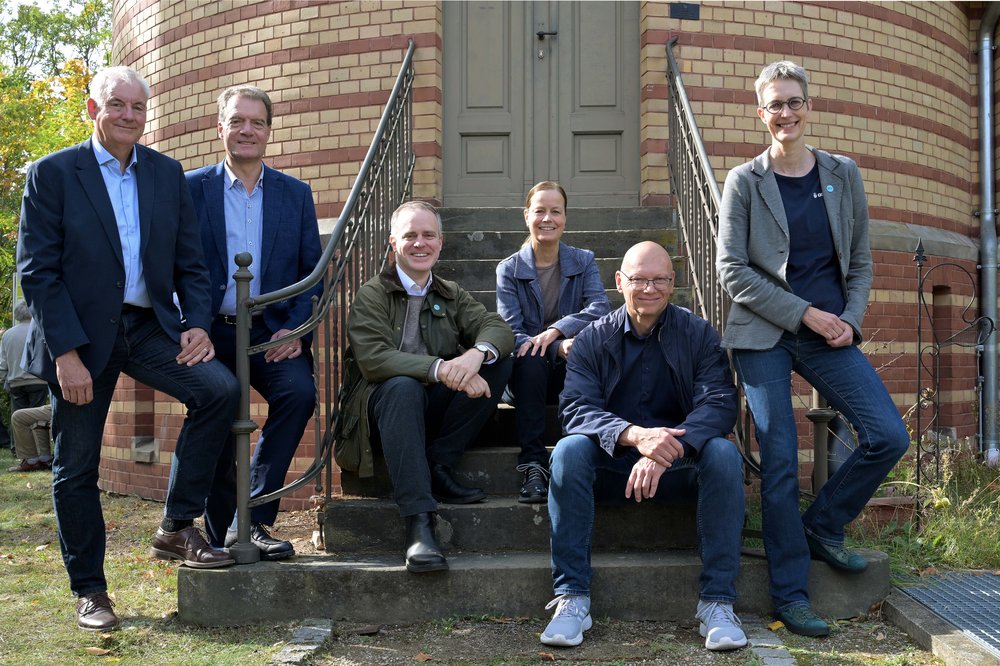
The heads of the four research institutes on the Telegrafenberg
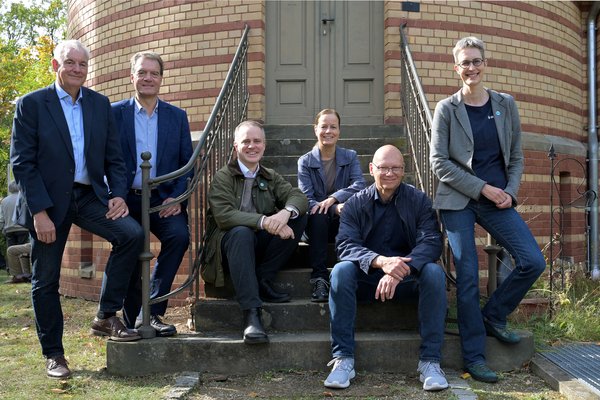
Big screen size [1000 x 666, 180 KB]
Original size [8256 x 5504, 5.3 MB]


The Einstein Tower attracted huge interest on Open Day

Big screen size [1000 x 666, 190 KB]
Original size [8256 x 5504, 6.6 MB]


Viele Potsdamer und Potsdamerinnen waren zum erstem Mal auf dem Telegrafenberg, andere freuten sich, wieder einmal da zu sein.

Big screen size [1000 x 666, 190 KB]
Original size [8256 x 5504, 4.6 MB]
