Dr Joseph Whittingham is awarded the Dissertation Prize for his research on galaxy mergers and radio relics
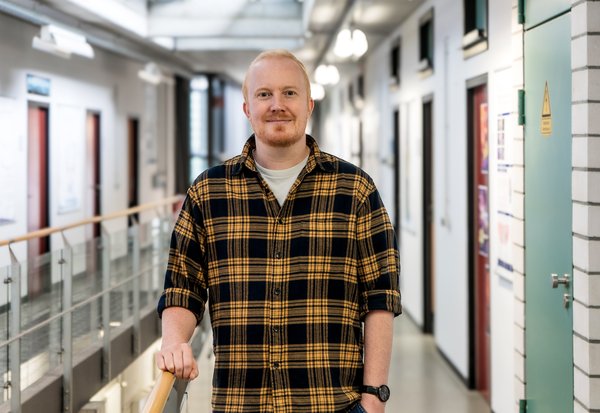
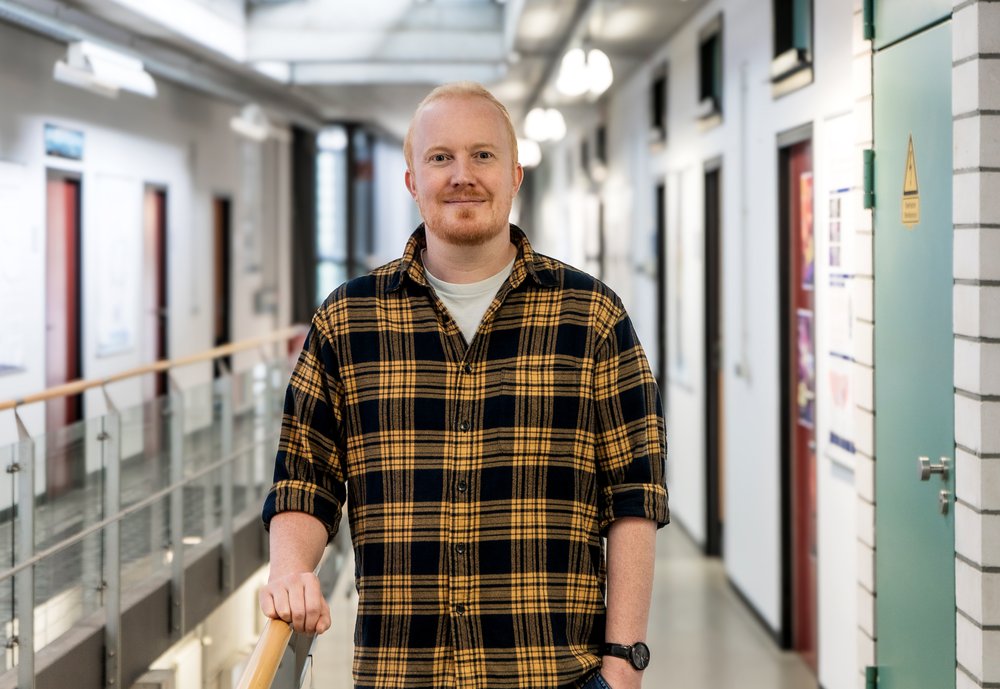
Dr. Joseph Whittingham
Credit: AIP, Tilo BergemannDr Joseph Whittingham receives a prize from the Physikalische Gesellschaft zu Berlin e.V. (Berlin Physical Society) for his doctoral thesis, which he completed under the supervision of Prof. Dr Christoph Pfrommer at the Leibniz Institute for Astrophysics Potsdam (AIP) and the University of Potsdam.
The dissertation, entitled ‘Merging galaxies and clusters: Insights into the role of magnetic fields and the physics of radio relics’ examines two fundamental questions in modern extragalactic astrophysics: the role of magnetic fields in the merging of disc galaxies and the physical processes that lead to the formation of radio relics in the outer regions of galaxy clusters. Both topics are crucial for understanding the evolution of cosmic structures and require high-resolution magnetohydrodynamic simulations, as developed and used at the AIP.
‘Through a series of cosmological 'zoom-in' simulations, I was able to demonstrate how sensitive galactic mergers are to the presence and amplification of magnetic fields,’ explains Joseph Whittingham. ‘The simulations show that magnetic fields fundamentally influence the transport of angular momentum during mergers, leading to widely differing final morphologies. In addition, I was able to identify a physical mechanism that explains how radio relics are created through the interaction of merger shocks, accretion shocks, and density fluctuations. It is a great honour for me to be recognised for this work.’
‘Dr Joseph Whittingham's thesis provides important new insights into the physics of galaxy mergers and radio relics,’ says Prof. Dr Christoph Pfrommer, head of the Cosmology and High Energy Astrophysics Department at the AIP. ‘His model for radio relics, in particular, provides elegant solutions to five major outstanding problems, and establishes a new benchmark for theoretical work on this subject. We are pleased that Joseph will continue to support us at the AIP with his work.’
The work of Joseph Whittingham analyses how shock waves arise and develop in galaxy clusters, tracing their effects through to observable radio emission. Using interconnected simulations on a range of different scales, he showed how different shock fronts interact, compressing gas and amplifying magnetic fields. This new model helps explain many properties of radio relics and provides a better understanding of how different parts can be probed by radio and X-ray observations.
The 2025 Dissertation Prize will be presented at a ceremony at the University of Potsdam, where the prize winners will showcase their award-winning work. The ceremony will take place on Wednesday, 10 December 2025, at 5:15 p.m. on the Golm University Campus, at the Institute of Physics and Astronomy, Karl-Liebknecht-Straße 24–25, 14476 Potsdam (Golm Campus, Building 28), in Lecture Hall 0.108.
Further information
Further information
https://pgzb.de/kalender/details/dissertationspreis-der-pgzb-2025
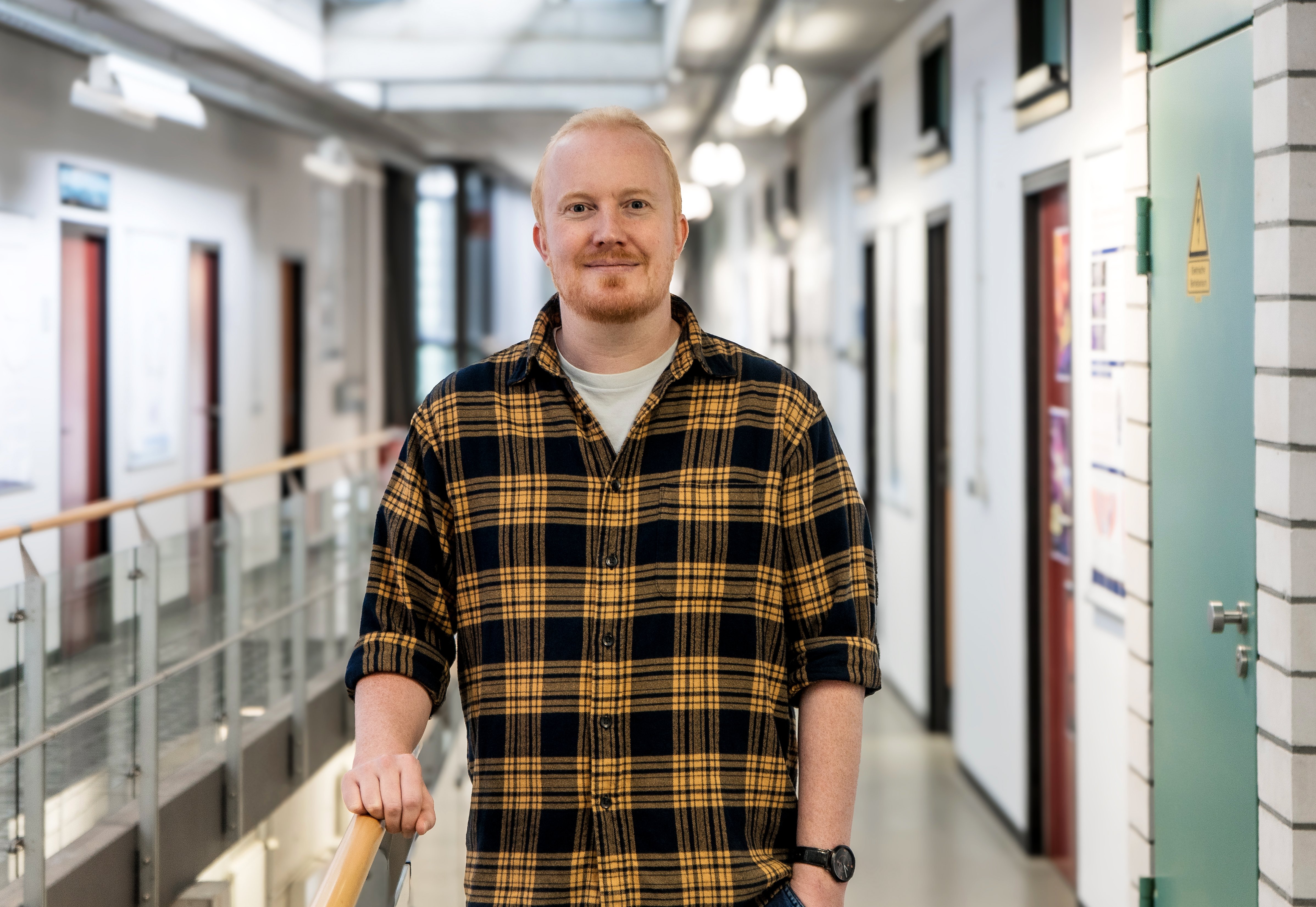
Dr. Joseph Whittingham
Credit: AIP, Tilo BergemannDr Joseph Whittingham receives a prize from the Physikalische Gesellschaft zu Berlin e.V. (Berlin Physical Society) for his doctoral thesis, which he completed under the supervision of Prof. Dr Christoph Pfrommer at the Leibniz Institute for Astrophysics Potsdam (AIP) and the University of Potsdam.
The dissertation, entitled ‘Merging galaxies and clusters: Insights into the role of magnetic fields and the physics of radio relics’ examines two fundamental questions in modern extragalactic astrophysics: the role of magnetic fields in the merging of disc galaxies and the physical processes that lead to the formation of radio relics in the outer regions of galaxy clusters. Both topics are crucial for understanding the evolution of cosmic structures and require high-resolution magnetohydrodynamic simulations, as developed and used at the AIP.
‘Through a series of cosmological 'zoom-in' simulations, I was able to demonstrate how sensitive galactic mergers are to the presence and amplification of magnetic fields,’ explains Joseph Whittingham. ‘The simulations show that magnetic fields fundamentally influence the transport of angular momentum during mergers, leading to widely differing final morphologies. In addition, I was able to identify a physical mechanism that explains how radio relics are created through the interaction of merger shocks, accretion shocks, and density fluctuations. It is a great honour for me to be recognised for this work.’
‘Dr Joseph Whittingham's thesis provides important new insights into the physics of galaxy mergers and radio relics,’ says Prof. Dr Christoph Pfrommer, head of the Cosmology and High Energy Astrophysics Department at the AIP. ‘His model for radio relics, in particular, provides elegant solutions to five major outstanding problems, and establishes a new benchmark for theoretical work on this subject. We are pleased that Joseph will continue to support us at the AIP with his work.’
The work of Joseph Whittingham analyses how shock waves arise and develop in galaxy clusters, tracing their effects through to observable radio emission. Using interconnected simulations on a range of different scales, he showed how different shock fronts interact, compressing gas and amplifying magnetic fields. This new model helps explain many properties of radio relics and provides a better understanding of how different parts can be probed by radio and X-ray observations.
The 2025 Dissertation Prize will be presented at a ceremony at the University of Potsdam, where the prize winners will showcase their award-winning work. The ceremony will take place on Wednesday, 10 December 2025, at 5:15 p.m. on the Golm University Campus, at the Institute of Physics and Astronomy, Karl-Liebknecht-Straße 24–25, 14476 Potsdam (Golm Campus, Building 28), in Lecture Hall 0.108.
Further information
Further information
https://pgzb.de/kalender/details/dissertationspreis-der-pgzb-2025
Images
Dr. Joseph Whittingham
Big screen size [1000 x 689, 110 KB]
Original size [4790 x 3301, 1.9 MB]