New Method Reveals Slower Expansion in Our Cosmic Neighborhood

The velocities of galaxies in groups versus distance. Embedded in the expanding Universe the attractive forces of gravity cluster the groups members together and cosmic expansion tears the outer member galaxies away. This balancing act jointly constrains the mass of the gravitationally-bound group and the Hubble constant being the expanding pull.
Credit: AIP/ D. Benisty / J. FohlmeisterTwo new studies have measured the expansion of the Universe in our immediate cosmic neighborhood using a novel method that analyzes the motion of two nearby galaxy groups within their surrounding cosmic flow. The results indicate that the local Universe is expanding more slowly than previously estimated, bringing measurements of nearby galaxies into close agreement with observations of the early Universe. The findings also suggest that less dark matter is required to explain the dynamics of galaxies within these groups than previously assumed.
The two studies were recently published in Astronomy & Astrophysics by an international team including David Benisty from the Leibniz Institute for Astrophysics Potsdam (AIP). Each paper analyzes observational data for a different nearby galaxy group — the Centaurus A group and the M81 group — to determine both their masses and the value of the Hubble constant.
The Hubble constant describes how fast the Universe expands, expressed as a ratio of the recessional velocity to the distance a galaxy has towards us. The Hubble constant is measured in km/s per Megaparsec, 1 Megaparsec being 3.3 million light years.
From the first light in the early Universe, the so-called cosmic microwave background radiation, a precise measurement for the Hubble constant with the value 68 km/s/Mpc was inferred. Using explosions of stars in receding galaxies to measure their distances, another very precise measurement of the Hubble constant could be established from our late, local Universe. However, the value is 73 km/s/Mpc.
This discrepancy between the expansion rates of the early and the late Universe is known as the Hubble tension. Over the last decades, increasingly precise observations have turned this tension into one of the central challenges in cosmology. It questions our understanding of cosmology and fundamental physics.
The new studies shed light onto this tension from a more holistic viewpoint in contrast to the approach based on stellar explosions. While the stellar-explosion method aims to directly track the cosmic expansion, the new studies analyze the motion of galaxies in groups embedded in the expanding Universe. The attractive forces of gravity cluster the groups together and cosmic expansion tears the member galaxies apart. This balancing act jointly constrains the mass of the gravitationally-bound group and the Hubble constant being the expanding pull. Surprisingly, David Benisty from AIP and his collaborators obtained a Hubble constant of about 64 km/s/Mpc. The result suggests that at least part of the Hubble tension may arise from the observations and methods we choose to infer the Hubble constant.
The researchers focused on two galaxy groups: The Centaurus A group is one of the nearest galaxy groups beyond the Milky Way’s own Local Group. It was assumed to be dominated by the giant elliptical galaxy Centaurus A and contains dozens of smaller satellite galaxies. The new analysis showed that the Centaurus A group is not centered around Centaurus A, but forms a binary with the M83 galaxy. The team thus determined the first value of the Hubble constant from this group as a binary and a more accurate mass estimate.
The M81 group is already known to have two galaxies, M81 and M82, in its center. Thanks to the extended dataset, the member galaxies around this binary were found to still form a planar structure, as previously established. The study of the turbulent dynamics shows that is yet so neatly ordered: The inner planar region with distances of less than 1 million light years is tilted by about 34 degrees to the larger-scale environment. At 10 million light years distance, the orientation has turned to align with the larger-scale sheet-like structure that also stretches out to the Centaurus A group.
Most intriguingly, the two galaxy groups do not only share a similar surrounding. They also have in common that the masses of the most luminous member galaxies almost entirely constitute the total group mass and that the motions of all galaxies in their vicinity are equally well described by the interplay between the galaxies' gravitational attraction and the cosmic pull. Hence, in contrast to simulated galaxy groups which are always embedded in an overall dark-matter halo, the observations of both galaxy groups can be well explained without this additional dark mass.
The team will use this method that gives a comprehensive understanding of structures in our cosmic neighborhood and transfer it to a larger cosmic volume. With new observations at larger distances, coming, for instance, from the 4-metre Multi-Object Spectroscopic Telescope (4MOST), the next data releases may not only bring a resolution to the Hubble tension but also yield a more precise census how much of this puzzling dark kind of matter is in our Universe.
This work was carried out in collaboration with David Benisty (AIP Potsdam), Jenny Wagner (Academia Sinica, Institute of Astronomy and Astrophysics, and University of Helsinki), Adrian Faucher (École Polytechnique), David Mota (University of Oslo), and Igor Karachentsev (Special Astrophysical Observatory, Russian Academy of Sciences).
Further information
The two studies were published in Astronomy & Astrophysics:
Adrian Faucher, David Benisty and David F. Mota (2026): Hubble-constant and -mass determination of Centaurus A and M83 from tip-of-red-giant-branch distances, A&A, 705, A112, DOI: https://doi.org/10.1051/0004-6361/202556283
Jenny Wagner, David Benisty and Igor D. Karachentsev (2026): The binary ballet: Mapping local expansion around M 81 and M 82, A&A, 706, A92, DOI: https://doi.org/10.1051/0004-6361/202557876
The velocities of galaxies in groups versus distance. Embedded in the expanding Universe the attractive forces of gravity cluster the groups members together and cosmic expansion tears the outer member galaxies away. This balancing act jointly constrains the mass of the gravitationally-bound group and the Hubble constant being the expanding pull.
Credit: AIP/ D. Benisty / J. FohlmeisterTwo new studies have measured the expansion of the Universe in our immediate cosmic neighborhood using a novel method that analyzes the motion of two nearby galaxy groups within their surrounding cosmic flow. The results indicate that the local Universe is expanding more slowly than previously estimated, bringing measurements of nearby galaxies into close agreement with observations of the early Universe. The findings also suggest that less dark matter is required to explain the dynamics of galaxies within these groups than previously assumed.
The two studies were recently published in Astronomy & Astrophysics by an international team including David Benisty from the Leibniz Institute for Astrophysics Potsdam (AIP). Each paper analyzes observational data for a different nearby galaxy group — the Centaurus A group and the M81 group — to determine both their masses and the value of the Hubble constant.
The Hubble constant describes how fast the Universe expands, expressed as a ratio of the recessional velocity to the distance a galaxy has towards us. The Hubble constant is measured in km/s per Megaparsec, 1 Megaparsec being 3.3 million light years.
From the first light in the early Universe, the so-called cosmic microwave background radiation, a precise measurement for the Hubble constant with the value 68 km/s/Mpc was inferred. Using explosions of stars in receding galaxies to measure their distances, another very precise measurement of the Hubble constant could be established from our late, local Universe. However, the value is 73 km/s/Mpc.
This discrepancy between the expansion rates of the early and the late Universe is known as the Hubble tension. Over the last decades, increasingly precise observations have turned this tension into one of the central challenges in cosmology. It questions our understanding of cosmology and fundamental physics.
The new studies shed light onto this tension from a more holistic viewpoint in contrast to the approach based on stellar explosions. While the stellar-explosion method aims to directly track the cosmic expansion, the new studies analyze the motion of galaxies in groups embedded in the expanding Universe. The attractive forces of gravity cluster the groups together and cosmic expansion tears the member galaxies apart. This balancing act jointly constrains the mass of the gravitationally-bound group and the Hubble constant being the expanding pull. Surprisingly, David Benisty from AIP and his collaborators obtained a Hubble constant of about 64 km/s/Mpc. The result suggests that at least part of the Hubble tension may arise from the observations and methods we choose to infer the Hubble constant.
The researchers focused on two galaxy groups: The Centaurus A group is one of the nearest galaxy groups beyond the Milky Way’s own Local Group. It was assumed to be dominated by the giant elliptical galaxy Centaurus A and contains dozens of smaller satellite galaxies. The new analysis showed that the Centaurus A group is not centered around Centaurus A, but forms a binary with the M83 galaxy. The team thus determined the first value of the Hubble constant from this group as a binary and a more accurate mass estimate.
The M81 group is already known to have two galaxies, M81 and M82, in its center. Thanks to the extended dataset, the member galaxies around this binary were found to still form a planar structure, as previously established. The study of the turbulent dynamics shows that is yet so neatly ordered: The inner planar region with distances of less than 1 million light years is tilted by about 34 degrees to the larger-scale environment. At 10 million light years distance, the orientation has turned to align with the larger-scale sheet-like structure that also stretches out to the Centaurus A group.
Most intriguingly, the two galaxy groups do not only share a similar surrounding. They also have in common that the masses of the most luminous member galaxies almost entirely constitute the total group mass and that the motions of all galaxies in their vicinity are equally well described by the interplay between the galaxies' gravitational attraction and the cosmic pull. Hence, in contrast to simulated galaxy groups which are always embedded in an overall dark-matter halo, the observations of both galaxy groups can be well explained without this additional dark mass.
The team will use this method that gives a comprehensive understanding of structures in our cosmic neighborhood and transfer it to a larger cosmic volume. With new observations at larger distances, coming, for instance, from the 4-metre Multi-Object Spectroscopic Telescope (4MOST), the next data releases may not only bring a resolution to the Hubble tension but also yield a more precise census how much of this puzzling dark kind of matter is in our Universe.
This work was carried out in collaboration with David Benisty (AIP Potsdam), Jenny Wagner (Academia Sinica, Institute of Astronomy and Astrophysics, and University of Helsinki), Adrian Faucher (École Polytechnique), David Mota (University of Oslo), and Igor Karachentsev (Special Astrophysical Observatory, Russian Academy of Sciences).
Further information
The two studies were published in Astronomy & Astrophysics:
Adrian Faucher, David Benisty and David F. Mota (2026): Hubble-constant and -mass determination of Centaurus A and M83 from tip-of-red-giant-branch distances, A&A, 705, A112, DOI: https://doi.org/10.1051/0004-6361/202556283
Jenny Wagner, David Benisty and Igor D. Karachentsev (2026): The binary ballet: Mapping local expansion around M 81 and M 82, A&A, 706, A92, DOI: https://doi.org/10.1051/0004-6361/202557876
Images

The velocities of galaxies in groups versus distance. Embedded in the expanding Universe the attractive forces of gravity cluster the groups members together and cosmic expansion tears the outer member galaxies away. This balancing act jointly constrains the mass of the gravitationally-bound group and the Hubble constant being the expanding pull.
Big screen size [1000 x 750, 80 KB]
Original size [5000 x 3750, 780 KB]

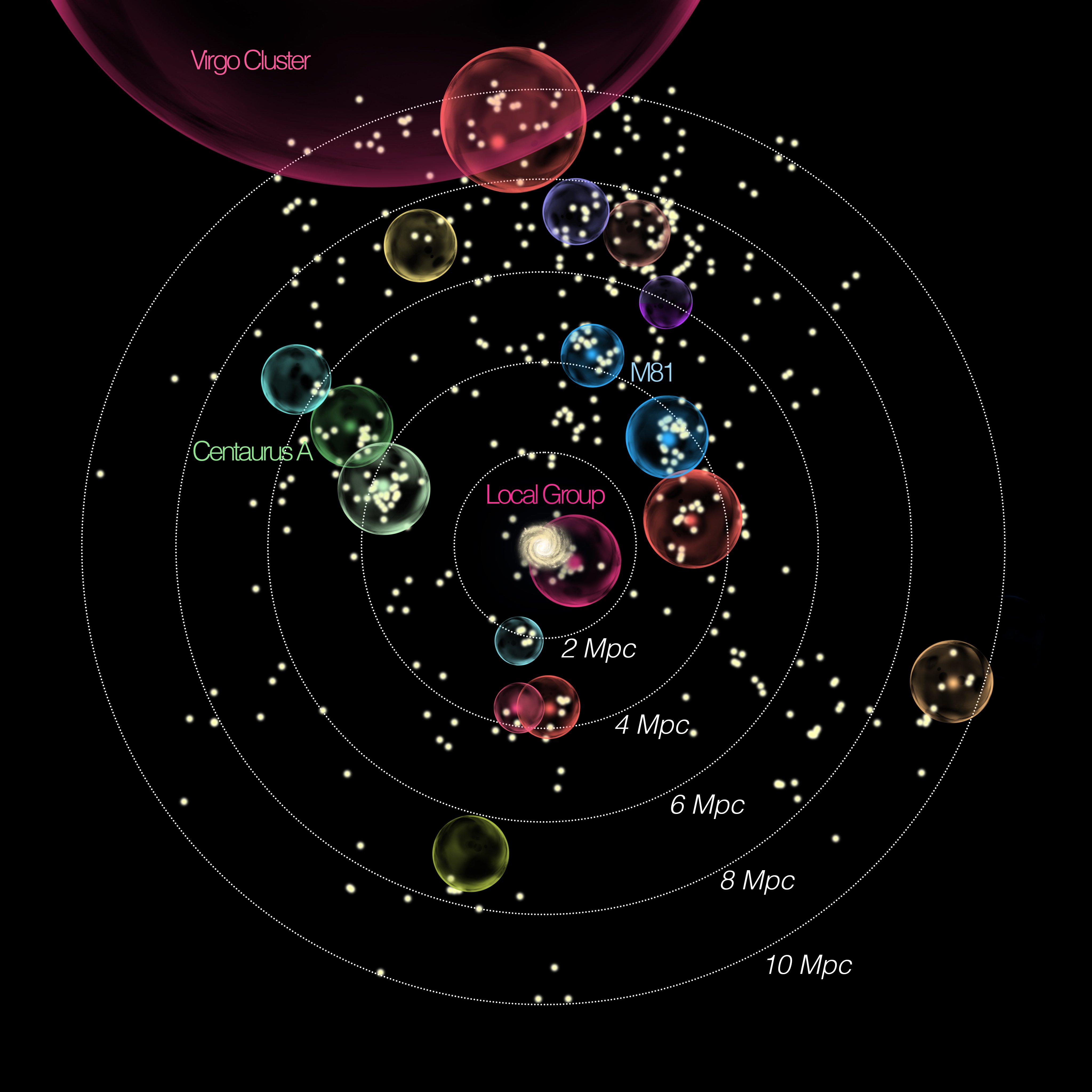
Filamentary structure of the local M81 group. The most luminous galaxies are marked in colour and their names are attached. The main planes of orientation depending on the volume in different radii are shown. Full video and description at: https://www.aanda.org/articles/aa/olm/2026/02/aa57876-25/aa57876-25.html
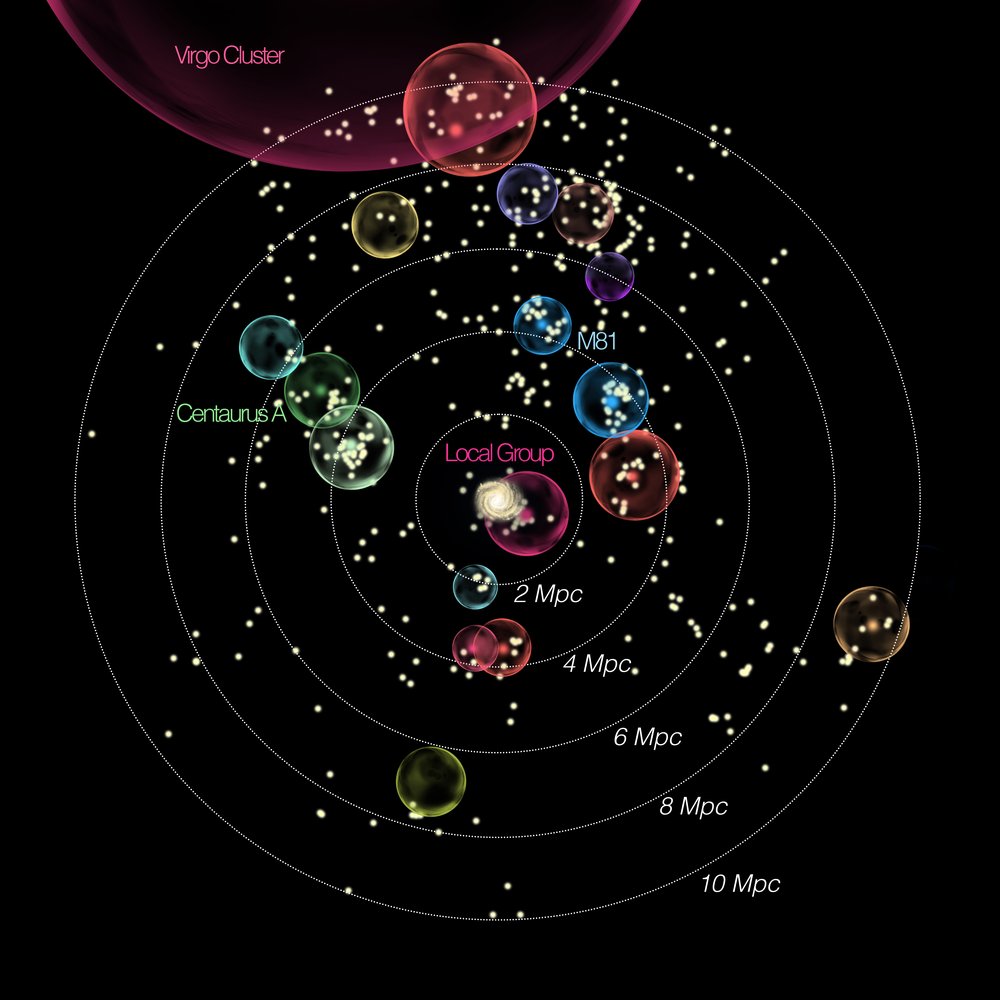
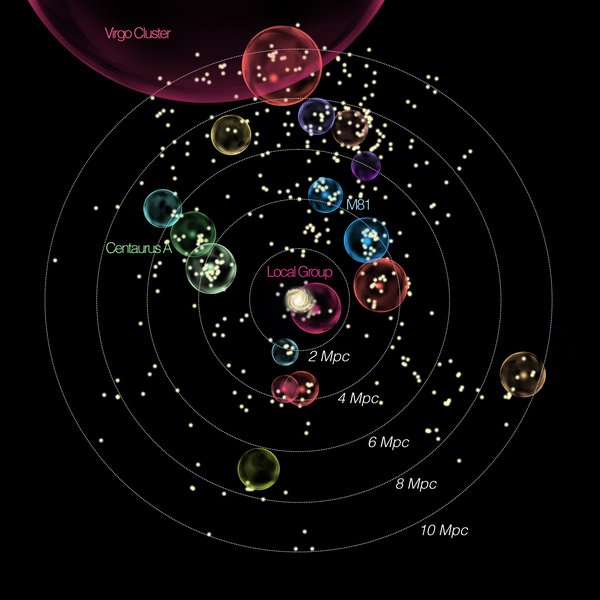
The distribution of galaxy groups around our local cosmic neighborhood. The studies focused on the Centaurus A and M81 groups.
Big screen size [1000 x 1000, 100 KB]
Original size [4096 x 4096, 640 KB]