Virtual lecture: Babelsberg Starry Night on 15th January 2026
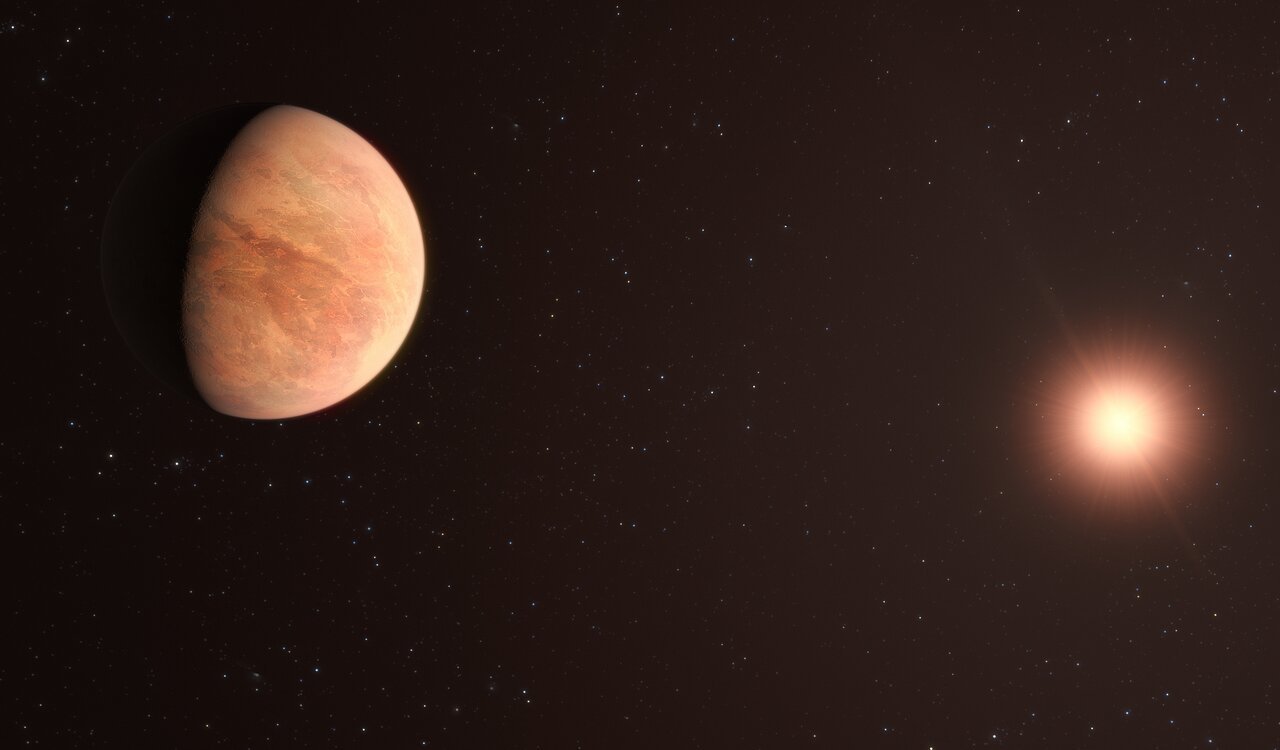
A star and his planet in an artist’s impression. How can stars and planets influence each other?
Credit: ESO/M. KornmesserThe next talk of the Virtual Babelsberg Starry Nights of the Leibniz Institute for Astrophysics Potsdam (AIP) entitled "The interactions between stars and planets" (in German) by Dr. Nikoleta Ilić Petković will be broadcast on the YouTube channel “Urknall, Weltall und das Leben” (Big Bang, Universe and Life) from Thursday, 15.01.2026.
Dr. Nikoleta Ilić Petković is a postdoctoral researcher in the Stellar Physics and Exoplanets research group. In her lecture, she explains how stars and their planets can influence each other. Two effects play a particularly important role: electromagnetic interaction and tidal interaction. We are familiar with both effects on Earth: when electrically charged particles from the solar wind are deflected by the Earth's magnetic field into the atmosphere, they can produce luminous auroras. This phenomenon has also been observed on other planets in the solar system, such as Jupiter, and can also occur on exoplanets.
The tidal forces of the Moon and Sun are responsible for the ebb and flow of the tides on Earth. However, the reverse influence of planets on their stars is very difficult to detect in the solar system. Here exoplanets come into play: many of these distant planets are so close to their host stars that measurable tidal and electromagnetic interactions can arise. The lecture explains these interactions and their possible consequences for the stars.
Usually on the 3rd Thursday of each month, starting at 8 p.m., the lectures of the Babelsberg Starry Nights become available at
https://www.aip.de/babelsberger-sternennaechte
and via the YouTube channels "Urknall, Weltall und das Leben" (Big Bang, Universe and Life) or "videowissen" and can be viewed afterwards at any time.
A star and his planet in an artist’s impression. How can stars and planets influence each other?
Credit: ESO/M. KornmesserThe next talk of the Virtual Babelsberg Starry Nights of the Leibniz Institute for Astrophysics Potsdam (AIP) entitled "The interactions between stars and planets" (in German) by Dr. Nikoleta Ilić Petković will be broadcast on the YouTube channel “Urknall, Weltall und das Leben” (Big Bang, Universe and Life) from Thursday, 15.01.2026.
Dr. Nikoleta Ilić Petković is a postdoctoral researcher in the Stellar Physics and Exoplanets research group. In her lecture, she explains how stars and their planets can influence each other. Two effects play a particularly important role: electromagnetic interaction and tidal interaction. We are familiar with both effects on Earth: when electrically charged particles from the solar wind are deflected by the Earth's magnetic field into the atmosphere, they can produce luminous auroras. This phenomenon has also been observed on other planets in the solar system, such as Jupiter, and can also occur on exoplanets.
The tidal forces of the Moon and Sun are responsible for the ebb and flow of the tides on Earth. However, the reverse influence of planets on their stars is very difficult to detect in the solar system. Here exoplanets come into play: many of these distant planets are so close to their host stars that measurable tidal and electromagnetic interactions can arise. The lecture explains these interactions and their possible consequences for the stars.
Usually on the 3rd Thursday of each month, starting at 8 p.m., the lectures of the Babelsberg Starry Nights become available at
https://www.aip.de/babelsberger-sternennaechte
and via the YouTube channels "Urknall, Weltall und das Leben" (Big Bang, Universe and Life) or "videowissen" and can be viewed afterwards at any time.