Shubham Mamgain
I am a science-enthusiast who like to learn about the evolution of the universe and deeply fascinated with the effort made in field of Astrophysics in the last two centuries.
My source of motivation to study comes from the realization that we, the living beings, functioning continuously due to the established complex network of billions of interacting microscopic organisms inside of our body, yet at fundamental level, each of them composed of a set of atoms of the periodic table. Since each distinct element is the product of nuclear fusion reaction occurring at the core of the stars, directly reminding us the fact that what appears distant out, is not so different than what we have inside.

Phone: +49 331 7499 687
smamgain@aip.de
Leibniz-Institut
für Astrophysik Potsdam (AIP)
An der Sternwarte 16
14482 Potsdam
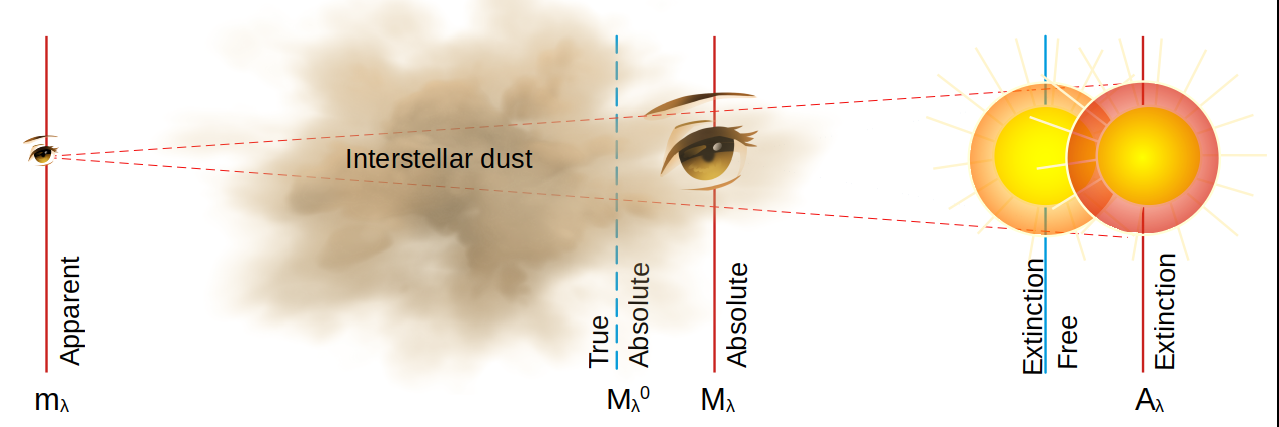
Luminosity-Distance-Reddening Calibration of a sample of Galactic Cepheid using multiband photometry (BVRIJHK)
Credit: Shubham Mamgain (University of Potsdam)Work in progess
My research aims to calibrate the Leavitt Law (1908) - a linear correlation between pulsation period of radially oscillating stars and their brightness. Cepheid variable stars are among the brightest stars within the galaxies, therefore can be spotted deep in the space (up to 200 million light years), allowing observational cosmology to constrain physical parameter like the expansion rate and the age of the Universe.
The Leavitt Law is intrinsic to Cepheid variable stars, opening the possibility to measure distances to their host galaxies, ultimately allowing astronomers to trace the spatial distribution of the galaxies within the the local Universe. Error in the spatial map directly relates with estimated distances of galaxies from the Leavitt Law, due to the scatter in observed data. I studied the brightness variation, in 3 optical and 3 infrared bands of light, of 150 Galactic Cepheid stars to understand the systematic error introduced by interstellar gas present in the line-of-sight. To constrain the systematics, I used a sample of the Cepheid stars with known distances measured by Gaia satellite of ESA (2023). To gain robust result, I also revised the calibration algorithm developed by astronomer Barry Madore (2017), and developed an automated python data pipeline which estimated the error correction for distance and interstellar extinction of individual Galactic Cepheids, then adjust the original dataset for corresponding corrections and ultimately yields the calibrated Leavitt Law with near zero scatter in infrared light (K -band).
Historical importance of Cepheid Variables
In astronomy, Leavitt Law serves as a primary standard tool for measuring distances to distant galaxies. From its discovery onwards, it changes the field of astronomy and the prespective of the astronomers about the Universe completely. Some of the important discovery made using the Leavitt Law are: the spiral structure of Milky Way (1918), realization of the Milky Way as an isolated galaxy (1924), the expansion of the Universe (1929), rotation of Milky Way (1934), estimation of age of the universe (1958), accelerated expansion of the Universe (1995), Calibration of SNIa based Cosmic Distance Ladder (1998) etc.
Leavitt Law calibration repository:
The python code for the calibration algorithm is hosted in GitHub repository.