Shubham Mamgain
My Journey
I am curious about the evolution of the universe and deeply fascinated with the effort made in field of Astrophysics in the last two centuries. My source of motivation comes from the realization that we, the living beings on the Earth, functioning due to a well-defined established network of microscopic organisms interacting inside of the body, in balanced with outer environment, yet at the fundamental level, each of them composed of a set of atoms of the periodic table. At moderate temperature and pressure, interactions between the atoms form molecules making life possible, at higher temperature atoms can be ionized and shines bright, and at extreme temperature they even can fuse with each other by nuclear processes as it happens at the core of the stars.

Phone: +49 331 7499 687
smamgain@aip.de
Leibniz-Institut
für Astrophysik Potsdam (AIP)
An der Sternwarte 16
14482 Potsdam
Stars are the production house of the all different elements, soaking free Hydrogen and other gases from the surrounding, and converting them to heavier elements like Helium, Carbon, Nitrogen, Oxygen, Silicon, Iron, Silver, Gold, Uranium etc. Each element of periodic table, up to Nickel, produced by series of nuclear fusion reactions undergoing at the core or surrounding shells of the core inside stars. Upon its death, it fuses all the rest heavier elements than Nickel through slow and rapid nuclear processes and expelled them in all directions.
Interestingly, all these elements are discovered in Earth, implying that Sun is a new generation star as it can not produce Gold, Silver, Uranium, etc. More amazing fact is what appears distant out - stars, nebulae, galaxies, or void, have not so different ingredients than what we are made of. This realization connects the evolution of universe to my personal journey, and the principles of physics narrates me the story of our evolution.
My Research Interests
- When was the Universe born? We are not sure, but it seems to have originated about 14 billion years ago, based on measurements of the Hubble constant.
- How was it born? We do not know for certain, but it appears that the Universe was once much smaller and denser, as observations show that it is rapidly expanding and getting cooler.
- How big is the Universe? We do not know. Because light travels at a finite speed, we cannot observe beyond the Hubble radius.
- What is the Universe made of? We do not know. Only about 5% of the Universe's energy content consists of ordinary matter that we can directly detect. The rest is believed to be dark matter and dark energy, both of which remain poorly understood.
- Are we alone in the Universe? We do not know yet. However, the possibility of life on exoplanets has become increasingly plausible following the discovery of dozens of potentially habitable planets within the Milky Way.
- What would our message be to technologically advanced civilizations? Perhaps we would ask how the Universe appears from their perspective and what value of the Hubble constant they observe.
- How would we communicate? Perhaps Andromeda Cepheids could serve as a galactic alphabet panel, with the slope of the Leavitt Law acting as a universal reference point.
- What can we do until a technologically advanced signal arrives? Deepen our understanding of the Universe and prepare ourself our minds for the new challenges.
My research thesis: Improved Reddenings, Distances and Luminosities for a new sample of Galactic Cepheids
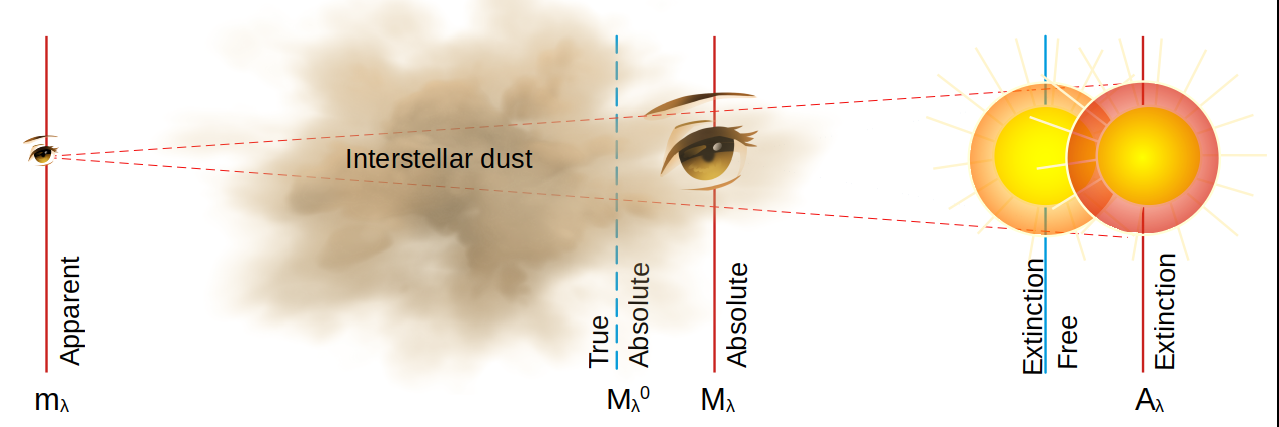
Luminosity-Distance-Reddening Calibration of a sample of Galactic Cepheid using multiband photometry (BVRIJHK)
Credit: Shubham Mamgain (University of Potsdam)My research aims to calibrate the Leavitt Law (1908) - a linear correlation between pulsation period of radially oscillating stars and their brightness. Cepheid variable stars are among the brightest stars within the galaxies, therefore can be spotted deep in the space (up to 200 million light years), allowing observational cosmology to constrain physical parameter like the expansion rate and the age of the Universe.
The Leavitt Law is intrinsic to Cepheid variable stars, opening the possibility to measure distances to their host galaxies, ultimately allowing astronomers to trace the spatial distribution of the galaxies within the the local Universe. Error in the spatial map directly relates with estimated distances of galaxies from the Leavitt Law, due to the scatter in observed data. I studied the brightness variation, in 3 optical and 3 infrared bands of light, of 150 Galactic Cepheid stars to understand the systematic error introduced by interstellar gas present in the line-of-sight. To constrain the systematics, I used a sample of the Cepheid stars with known distances measured by Gaia satellite of ESA (2023). To gain robust result, I also revised the calibration algorithm developed by astronomer Barry Madore (2017), and developed an automated python data pipeline which estimated the error correction for distance and interstellar extinction of individual Galactic Cepheids, then adjust the original dataset for corresponding corrections and ultimately yields the calibrated Leavitt Law with near zero scatter in infrared light (K -band).
Historical importance of Cepheid Variables
In astronomy, Leavitt Law serves as a primary standard tool for measuring distances to distant galaxies. From its discovery onwards, it changes the field of astronomy and the prespective of the astronomers about the Universe completely. Some of the important discovery made using the Leavitt Law are: the spiral structure of Milky Way (1918), realization of the Milky Way as an isolated galaxy (1924), the expansion of the Universe (1929), rotation of Milky Way (1934), estimation of age of the universe (1958), accelerated expansion of the Universe (1995), Calibration of SNIa based Cosmic Distance Ladder (1998) etc.
Leavitt Law calibration repository:
The python code for the calibration algorithm is hosted in GitHub repository.
Research Application
With multiband photometry of Cepheids, probing 3D structure of Small Magellanic Cloud and interstellar dust distribution as color coded.
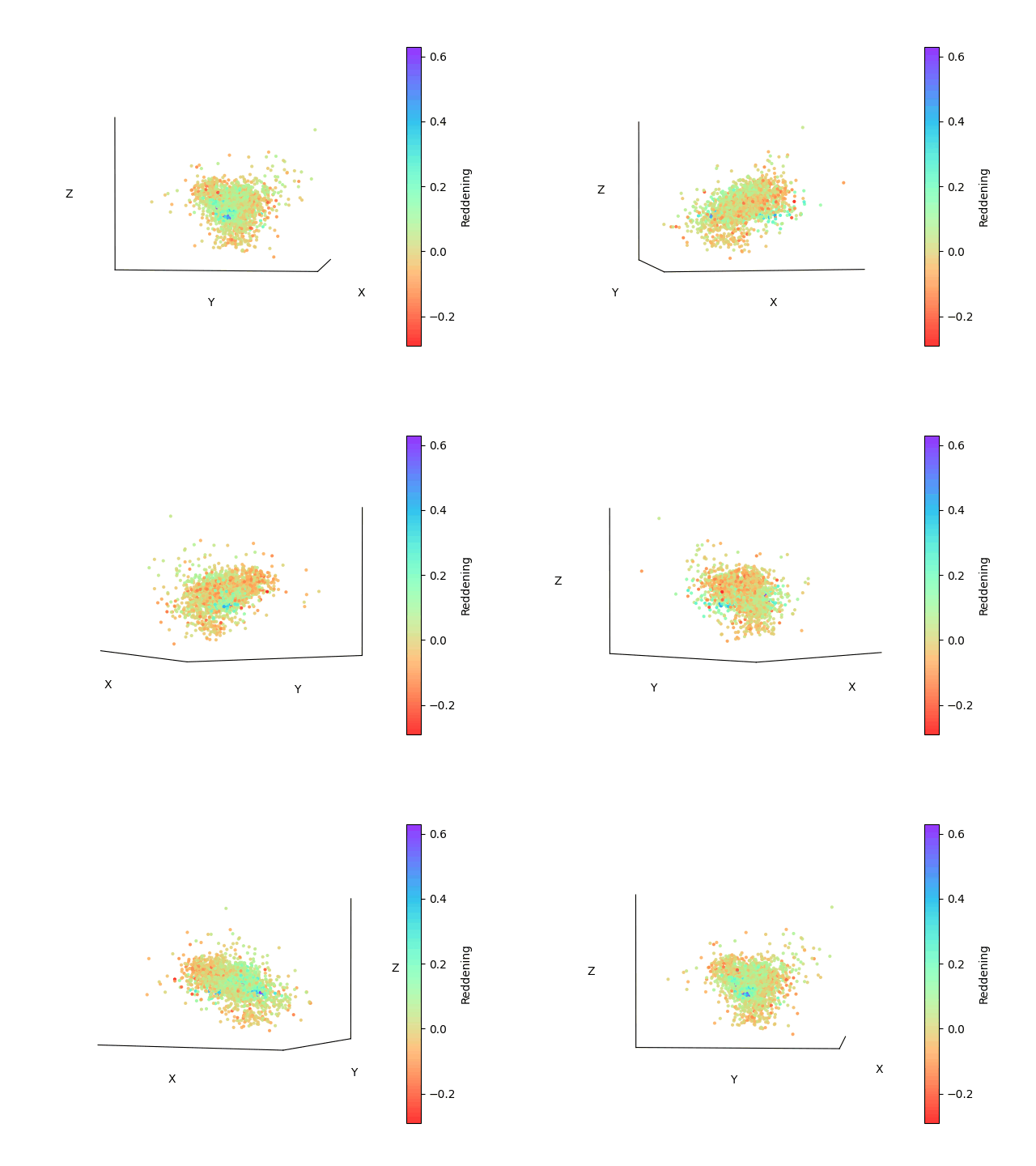
Three-dimensional mapping of the Small Magellanic Cloud using multiband BVIJHK photometry of Cepheid variables. Reddening effect of individual Cepheid is color coded.
Credit: Shubham Mamgain (DGGH, AIP)