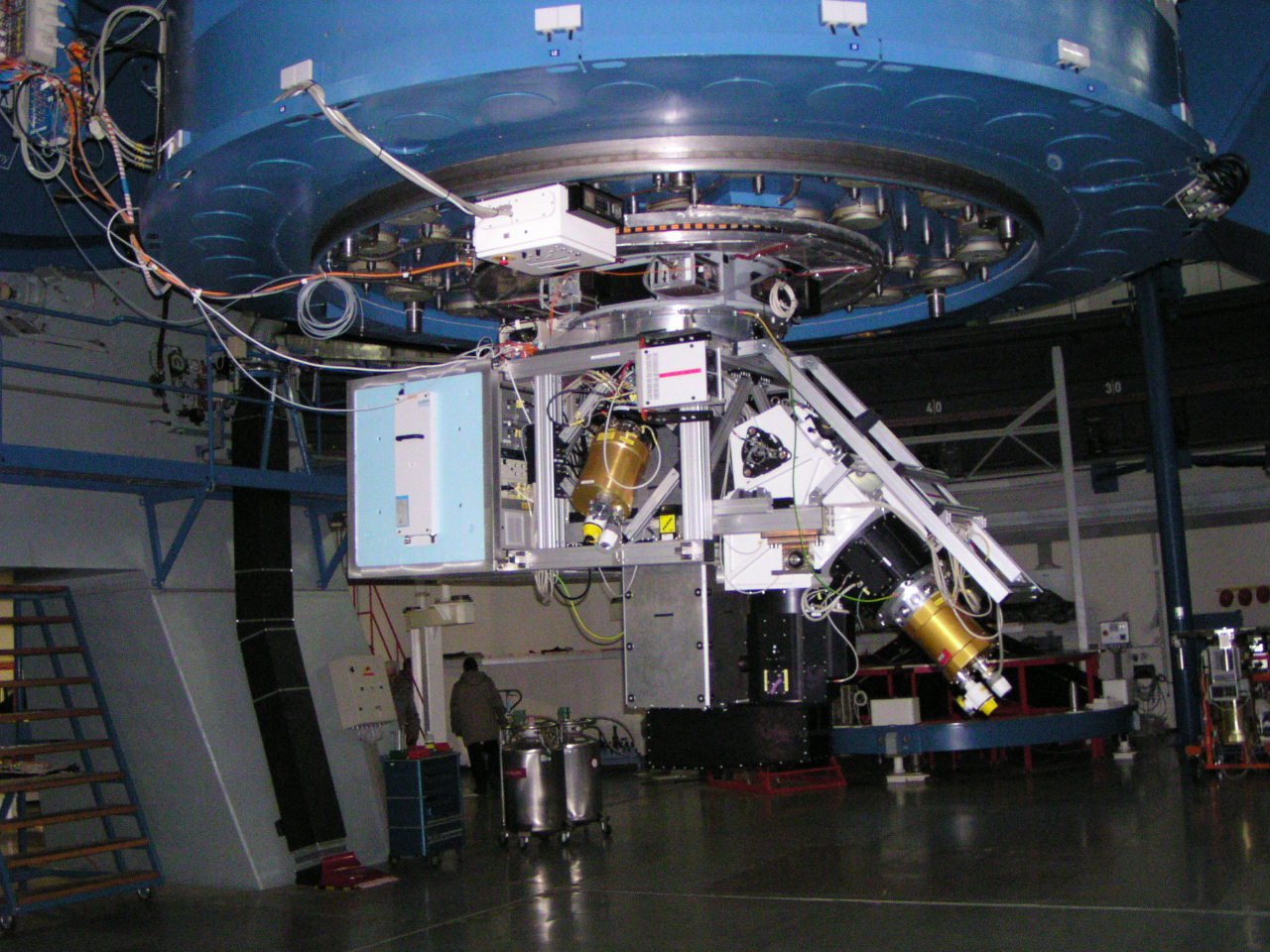
The Legacy of 25 years of PMAS at Calar Alto Observatory
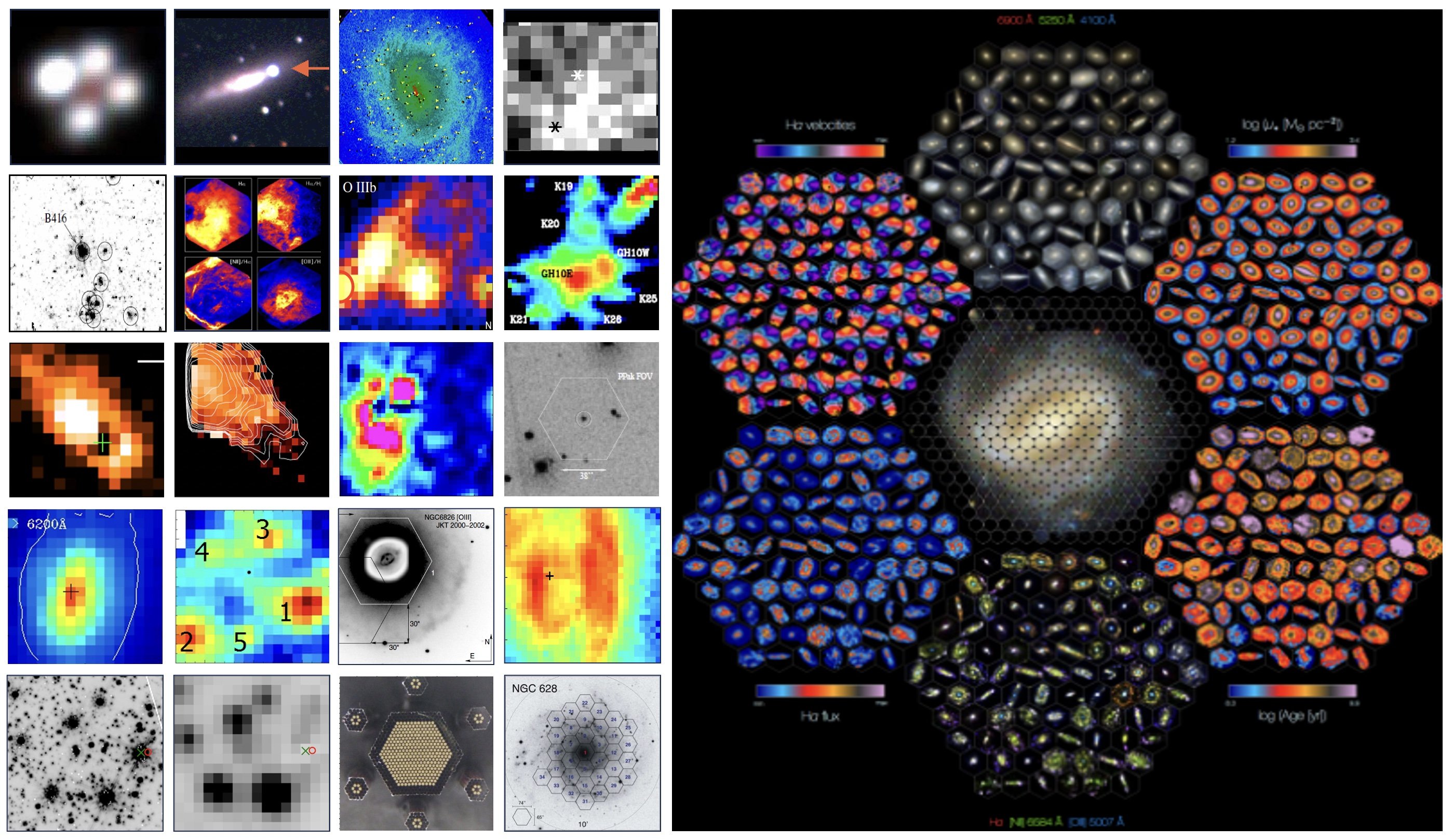
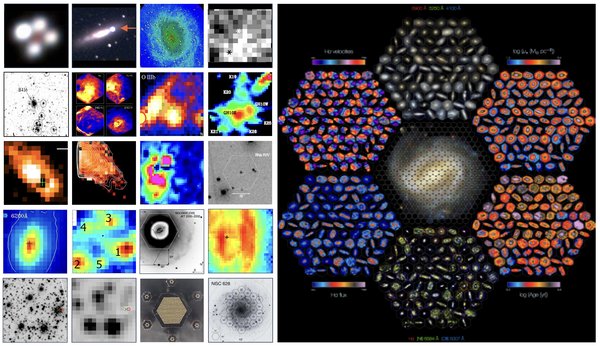
Kaleidoscope of PMAS observations for a multitude of different objects, ranging from the Milky Way to high redshift galaxies.
Credit: AIP, CAHA & CALIFA Survey. Acknowledgements: L. Wisotzki, L. Christensen, M. Roth, T. Becker, S. F. Sanchez, I. Lehmann, R. López, B. Husemann, C. Kehrig, P. Ferrero, A. Allonso-Herrero, L. M. Cairós, A. Monreal Ibero, S. Kamann, C. Sandin, F. Ros.-OrtegaThe Leibniz Institute for Astrophysics Potsdam (AIP) and the Centro Astronómico Hispano en Andalucía, Observatorio de Calar Alto (CAHA), jointly celebrate 25 years of operation of PMAS, the Potsdam Multi-Aperture Spectrophotometer: It was on May 29th, 2001, when the PMAS team, supported by CAHA staff, achieved First Light for the then new instrument at the 3.5m Telescope on Calar Alto.
The development of this first generation integral field spectrograph began in 1996 with financial support from the German BMBF Verbundforschung and was completely conducted in-house as the first instrument of the still young AIP. From the outset, PMAS was conceptually thought to be an experimental instrument, potentially to be tested at different telescopes, but not a facility instrument. At the AIP inventory, it is still registered today as “travel spectrograph”. However, after completion in Potsdam it travelled only once, namely to Calar Alto Observatory where it was found to be competitive at a time when various groups world-wide were commissioning first generation integral field spectrographs. Under an agreement with the Deutsch-Spanisches Astromomische Zentrum (DSAZ) and Max Planck Institute for Astronomy, Heidelberg, PMAS was offered on a shared risk base to the community and has ever since operated as a common user instrument.
After the transition from DSAZ to the entirely Spanish-led CAHA Observatory, the excellent collaboration between AIP and Calar Alto has been maintained as a cornerstone of the long-term success of PMAS. Jesús Aceituno, Director of Calar Alto, states: “The sustained scientific productivity of the instrument over 25 years has been possible not only because of its capabilities, but also thanks to the long-term operational stability of Calar Alto Observatory, the continuous local technical support, and the observatory’s commitment to providing reliable access to the astronomical community.” Over the years, CAHA has proven to be an excellent platform for visitor instrumentation and long-term scientific programs, enabling PMAS to remain a competitive and productive facility instrument for the international community.
As the acronym implies, PMAS was designed for imaging spectrophotometry. “This was a novelty in the early 2000s!”, remembers Martin Roth, the Principle Investigator of PMAS. “The instrument exhibits a high throughput from the ultraviolet to the near infrared light, as the fully refractive spectrograph employs calcium fluoride apochromatic lenses with highly efficient broad-band anti-reflective coatings”, explains Martin Roth. The integral field unit (IFU) is a fiber-coupled lens-array. As an upgrade, PMAS received an additional fiber-bundle IFU with a highly competitive wide field-of-view of over one arcmin across.
With these capabilities, PMAS was soon recognized by the community as an attractive facility. Already in the early years, numerous applications from various different fields resulted in publications, many of those were unique at the time. The picture with a kaleidoscope of publications, with no attempt whatsoever to be complete, illustrates the broad range of science that has been covered early on. Arguably, the Calar Alto Legacy Integral Field Area Survey (CALIFA), launched in 2012 by Calar Alto and an international team of astronomers, that mapped and analyzed 600 nearby galaxies, has become a success story that still today is spawning papers from an unmatched data base. PMAS observations have resulted in a total of more than 450 scientific publications, among these 313 were using CALIFA data and received about 13,000 citations in total so far.
Among the most important discoveries are the world’s first observations of a supernova as well as of a Gamma Ray Burst optical counterpart with integral field spectroscopy, the evidence of microlensing in a gravitationally lensed quasar, the detection of the foreground galaxy responsible for a damped Lyman Alpha quasar absorption system in emission, or the discrimination of contaminating supernova remnants from the luminosity function of extragalactic planetary nebulae. Results from CALIFA include the robust evidence for inside-out assembly of galaxies, the universal occurrence of galaxy metallicity gradients in the gas phase, the description of galaxy quenching, or the variation of star formation efficiency as jointly derived with carbon monoxide data from the CALIFA-EDGE survey.
In addition, Martin Roth mentions: “Many early-stage researchers and PhD students were trained here and supplied with original PMAS data for their science projects. A particularly successful example has been the demonstration of crowded-field spectroscopy as part of the PhD thesis of Sebastian Kamann, who only recently was awarded the Johann Wempe Price for his achievements with this innovation.”
Happy birthday, PMAS!
Further information
PMAS Website: https://www.aip.de/en/research/projects/pmas/
Roth M.M., Kelz A., Fechner T., Hahn T., Bauer S.-M., Becker T., Böhm P., et al., 2005, PASP, 117, 620. doi:10.1086/429877
Kelz A., Verheijen M. A. W., Roth M. M., Bauer S. M., Becker T., Paschke J., Popow E., et al., 2006, PASP, 118, 129. doi:10.1086/497455
Sánchez, S. F., Kennicutt, R. C., Gil de Paz, A., van de Ven, G., Vílchez J. M., Wisotzki, L., Walcher, C. J., et al., 2012, A&A, 538, A8.
Kaleidoscope of PMAS observations for a multitude of different objects, ranging from the Milky Way to high redshift galaxies.
Credit: AIP, CAHA & CALIFA Survey. Acknowledgements: L. Wisotzki, L. Christensen, M. Roth, T. Becker, S. F. Sanchez, I. Lehmann, R. López, B. Husemann, C. Kehrig, P. Ferrero, A. Allonso-Herrero, L. M. Cairós, A. Monreal Ibero, S. Kamann, C. Sandin, F. Ros.-OrtegaThe Leibniz Institute for Astrophysics Potsdam (AIP) and the Centro Astronómico Hispano en Andalucía, Observatorio de Calar Alto (CAHA), jointly celebrate 25 years of operation of PMAS, the Potsdam Multi-Aperture Spectrophotometer: It was on May 29th, 2001, when the PMAS team, supported by CAHA staff, achieved First Light for the then new instrument at the 3.5m Telescope on Calar Alto.
The development of this first generation integral field spectrograph began in 1996 with financial support from the German BMBF Verbundforschung and was completely conducted in-house as the first instrument of the still young AIP. From the outset, PMAS was conceptually thought to be an experimental instrument, potentially to be tested at different telescopes, but not a facility instrument. At the AIP inventory, it is still registered today as “travel spectrograph”. However, after completion in Potsdam it travelled only once, namely to Calar Alto Observatory where it was found to be competitive at a time when various groups world-wide were commissioning first generation integral field spectrographs. Under an agreement with the Deutsch-Spanisches Astromomische Zentrum (DSAZ) and Max Planck Institute for Astronomy, Heidelberg, PMAS was offered on a shared risk base to the community and has ever since operated as a common user instrument.
After the transition from DSAZ to the entirely Spanish-led CAHA Observatory, the excellent collaboration between AIP and Calar Alto has been maintained as a cornerstone of the long-term success of PMAS. Jesús Aceituno, Director of Calar Alto, states: “The sustained scientific productivity of the instrument over 25 years has been possible not only because of its capabilities, but also thanks to the long-term operational stability of Calar Alto Observatory, the continuous local technical support, and the observatory’s commitment to providing reliable access to the astronomical community.” Over the years, CAHA has proven to be an excellent platform for visitor instrumentation and long-term scientific programs, enabling PMAS to remain a competitive and productive facility instrument for the international community.
As the acronym implies, PMAS was designed for imaging spectrophotometry. “This was a novelty in the early 2000s!”, remembers Martin Roth, the Principle Investigator of PMAS. “The instrument exhibits a high throughput from the ultraviolet to the near infrared light, as the fully refractive spectrograph employs calcium fluoride apochromatic lenses with highly efficient broad-band anti-reflective coatings”, explains Martin Roth. The integral field unit (IFU) is a fiber-coupled lens-array. As an upgrade, PMAS received an additional fiber-bundle IFU with a highly competitive wide field-of-view of over one arcmin across.
With these capabilities, PMAS was soon recognized by the community as an attractive facility. Already in the early years, numerous applications from various different fields resulted in publications, many of those were unique at the time. The picture with a kaleidoscope of publications, with no attempt whatsoever to be complete, illustrates the broad range of science that has been covered early on. Arguably, the Calar Alto Legacy Integral Field Area Survey (CALIFA), launched in 2012 by Calar Alto and an international team of astronomers, that mapped and analyzed 600 nearby galaxies, has become a success story that still today is spawning papers from an unmatched data base. PMAS observations have resulted in a total of more than 450 scientific publications, among these 313 were using CALIFA data and received about 13,000 citations in total so far.
Among the most important discoveries are the world’s first observations of a supernova as well as of a Gamma Ray Burst optical counterpart with integral field spectroscopy, the evidence of microlensing in a gravitationally lensed quasar, the detection of the foreground galaxy responsible for a damped Lyman Alpha quasar absorption system in emission, or the discrimination of contaminating supernova remnants from the luminosity function of extragalactic planetary nebulae. Results from CALIFA include the robust evidence for inside-out assembly of galaxies, the universal occurrence of galaxy metallicity gradients in the gas phase, the description of galaxy quenching, or the variation of star formation efficiency as jointly derived with carbon monoxide data from the CALIFA-EDGE survey.
In addition, Martin Roth mentions: “Many early-stage researchers and PhD students were trained here and supplied with original PMAS data for their science projects. A particularly successful example has been the demonstration of crowded-field spectroscopy as part of the PhD thesis of Sebastian Kamann, who only recently was awarded the Johann Wempe Price for his achievements with this innovation.”
Happy birthday, PMAS!
Further information
PMAS Website: https://www.aip.de/en/research/projects/pmas/
Roth M.M., Kelz A., Fechner T., Hahn T., Bauer S.-M., Becker T., Böhm P., et al., 2005, PASP, 117, 620. doi:10.1086/429877
Kelz A., Verheijen M. A. W., Roth M. M., Bauer S. M., Becker T., Paschke J., Popow E., et al., 2006, PASP, 118, 129. doi:10.1086/497455
Sánchez, S. F., Kennicutt, R. C., Gil de Paz, A., van de Ven, G., Vílchez J. M., Wisotzki, L., Walcher, C. J., et al., 2012, A&A, 538, A8.
Images
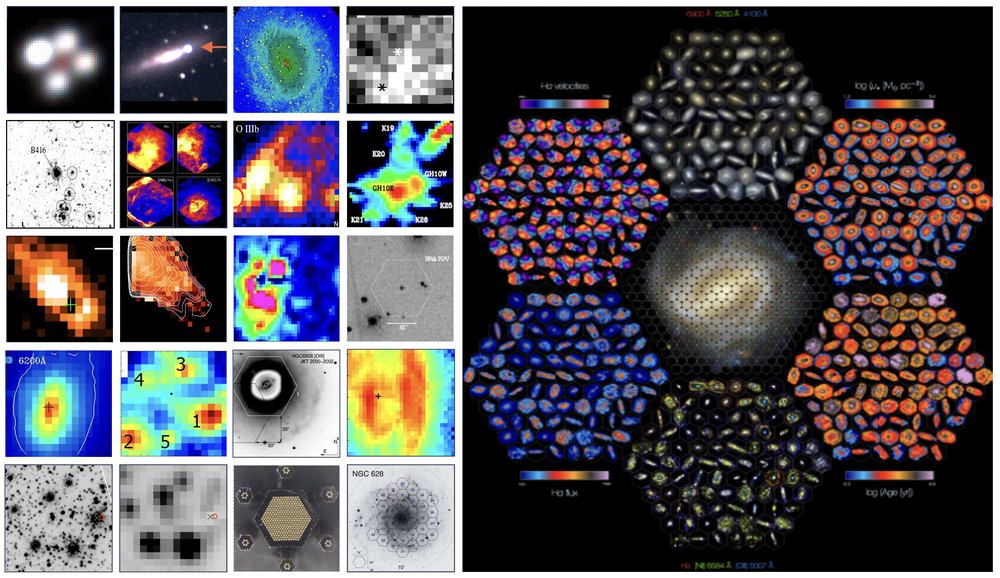
Kaleidoscope of PMAS observations for a multitude of different objects, ranging from the Milky Way to high redshift galaxies.
Big screen size [1000 x 578, 150 KB]
Original size [2798 x 1618, 660 KB]
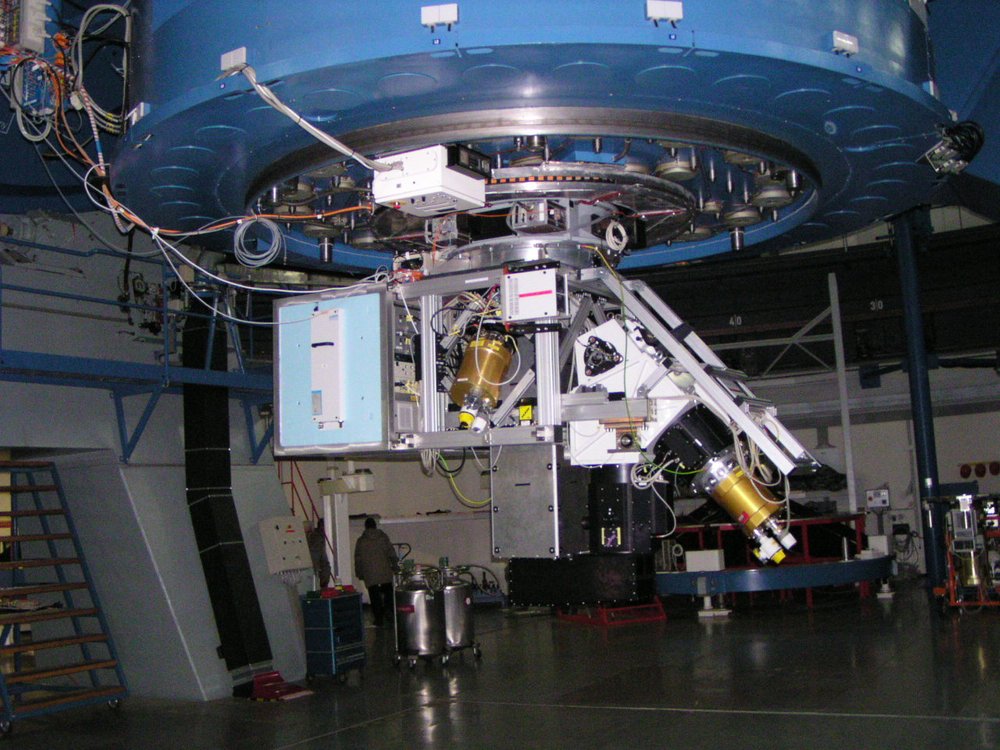
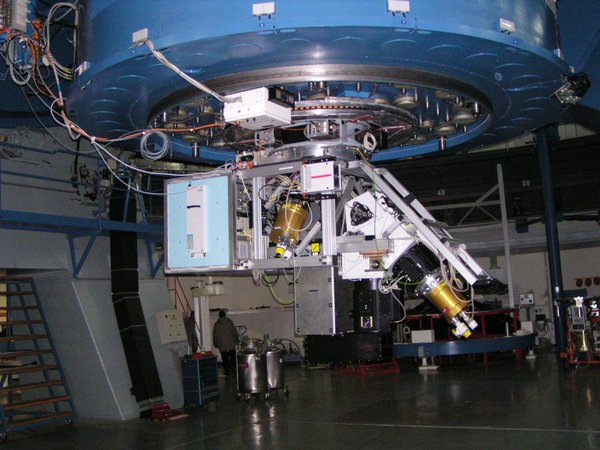
PMAS instrument at the Cassegrain focus of the Calar Alto 3.5m telescope.
Big screen size [1000 x 750, 150 KB]
Original size [1280 x 960, 230 KB]