BlueMUSE Agreement: blue light for ESO’s Very Large Telescope
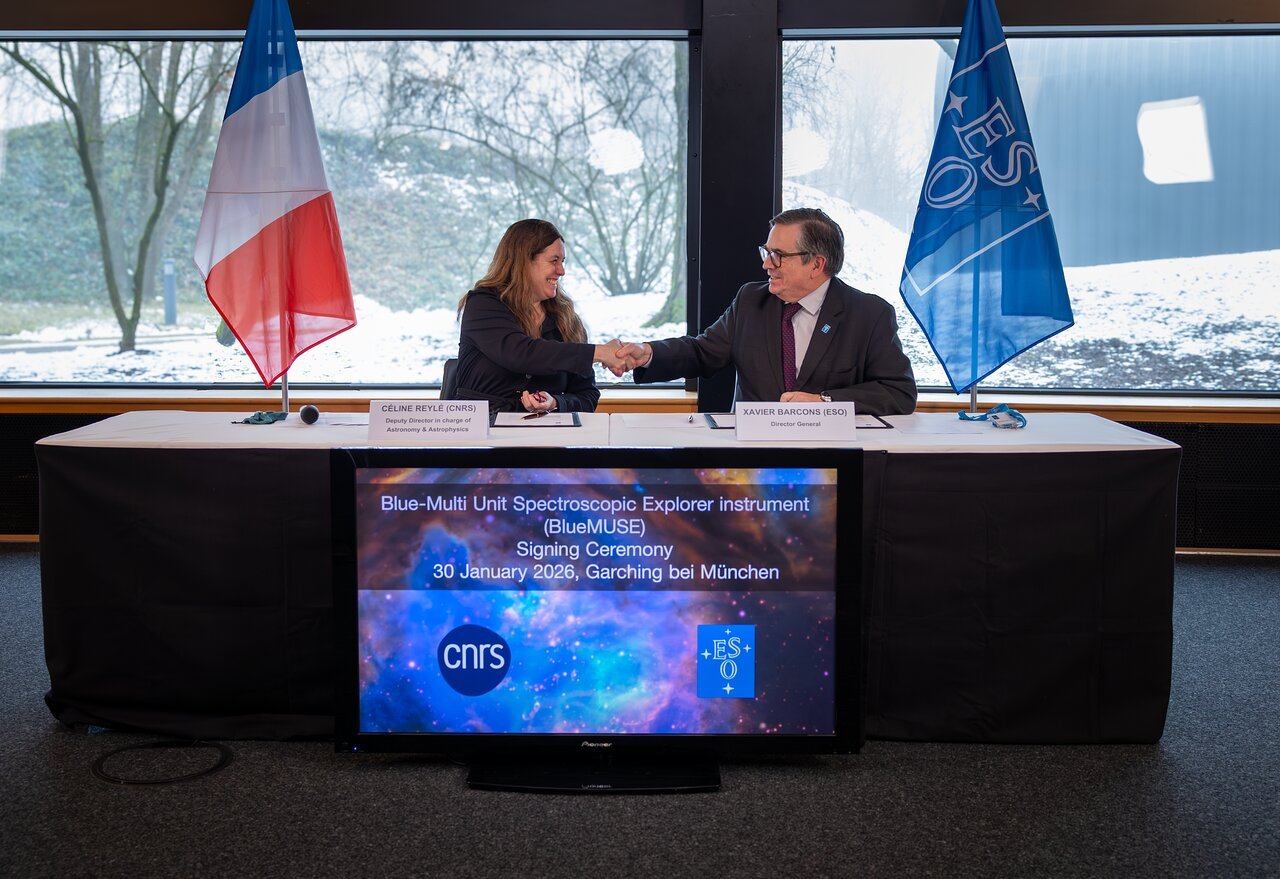
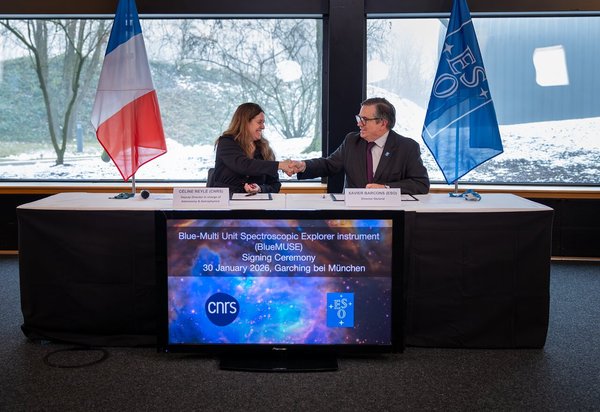
Céline Reylé, the Deputy Director for Science for Astronomy and Astrophysics at the French National Centre for Scientific Research (CNRS) and Xavier Barcons (Director General, ESO) sign the contract for BlueMUSE, an upcoming instrument for ESO’s Very Large Telescope (VLT)
Credit: ESOOn January 30th, 2026, the European Southern Observatory (ESO) signed an agreement with a large international consortium for the design and construction of BlueMUSE (Blue Multi Unit Spectroscopic Explorer), a blue-optimised panoramic integral field spectrograph being developed for ESO's Very Large Telescope (VLT). With its large field of view, high spectral resolution, and exceptional efficiency in the blue wavelength range, BlueMUSE will enable unique observations.
ESO’s Director General Xavier Barcons and Céline Reylé, the Deputy Director for Science for Astronomy and Astrophysics at the French National Centre for Scientific Research (CNRS), signed the BlueMUSE agreement at the ESO Headquarters in Garching, Germany. The CNRS’s Centre de Recherche Astrophysique de Lyon (CRAL) is the institution leading the instrument consortium, which consists of multiple institutes from Europe and Australia.
The Leibniz Institute for Astrophysics Potsdam (AIP) participates in key technical work packages of BlueMUSE. Peter Weilbacher, head of the project, which is also funded by the BMFTR, states: ‘Together with our university partners in Potsdam and Göttingen, the AIP provides significant developments to the instrumental hardware, the data reduction software and the preparation for its scientific use.’
Based on the successful technology of the MUSE instrument installed at the VLT, BlueMUSE is an integral-field spectrograph. It is designed to not only capture a 2D image of a target (or multiple targets) but also split the light into its component colours or wavelengths at each pixel, resulting in a full 3D dataset with comprehensive information on the target object. As MUSE has become one of the most productive and requested ESO instruments, the astronomical community has been hoping for a similar instrument for some time — this is now becoming a reality.
‘BlueMUSE is both a discovery and a follow-up instrument, working under the concept of “spectroscopy of everything”, providing a spectrum for every object in its field-of-view,’ explains Davor Krajnović, the project scientist. ‘BlueMUSE is particularly suitable for studies of galaxies in the redshift range z ≈ 2–4, the so-called ‘Cosmic Noon’, a crucial period in galaxy formation,’ he says. In addition, the instrument allows detailed investigations of diffuse gas around galaxies.
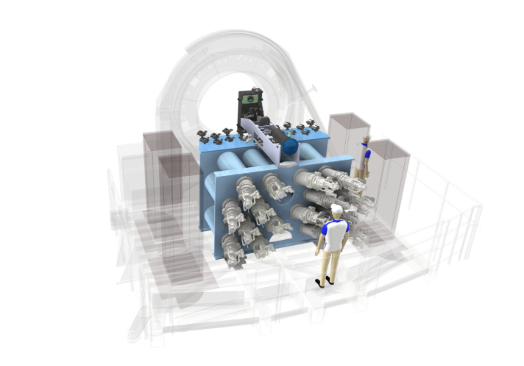
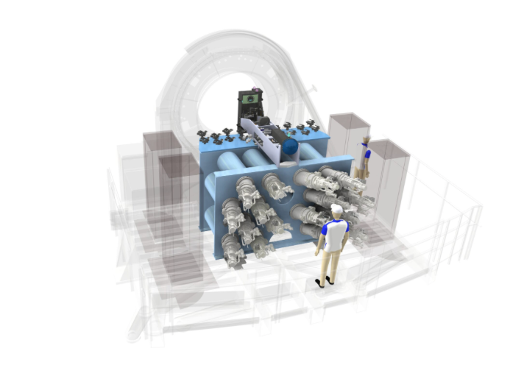
‘As a partner in the BlueMUSE consortium, the AIP contributes its many years of expertise in research and development,’ says Andreas Kelz, head of the instrumentation programme. ‘The BlueMUSE instrument is made up of a total of 16 spectrographs that cover the blue and visible wavelength range and will be one of the most efficient spectrographs at the VLT.’ he adds. The instrument can be thought of delivering about 60,000 spectra or 3,500 images for each exposure.
Anticipated to see first-light in 2034, BlueMUSE will enable the spectroscopic investigation of extensive regions of the sky and has great synergy potential for large-area sky surveys. The instrument also offers new perspectives for exploring the local universe. Astronomers will be able to use it to study objects in the solar system, stellar environments and gaseous nebulae in the Milky Way, faint dwarf galaxies in the Local Group, as well as galaxies, galaxy groups and clusters, and the gas between them.
More Information
The BlueMUSE project will be built by an international consortium composed of 9 research institutes in multiple countries and ESO. The consortium consists of
- Australia: Australian Astronomical Optics, Macquarie University
- France: Centre de Recherche Astrophysique de Lyon (CRAL; lead); Astrophysique, Instrumentation & Modélisation (AIM), Saclay; Institut de Recherche sur les lois Fondamentales de l’Univers, Saclay
- Germany: Leibniz Institute for Astrophysics Potsdam (AIP) in association with University of Potsdam and University of Göttingen
- Portugal: Institute of Astrophysics and Space Sciences
- Sweden: Department of Astronomy, Stockholm University
- Switzerland: Observatoire astronomique de l’Université de Genève; Laboratory of Astrophysics, Ecole Polytechnique Fédérale de Lausanne (EPFL)
- United Kingdom: Centre for Advanced Instrumentation and Centre for Extragalactic Astronomy, Physics Department, Durham University
ESO also contributes to the project development.
Further information
https://bluemuse.univ-lyon1.fr
Images
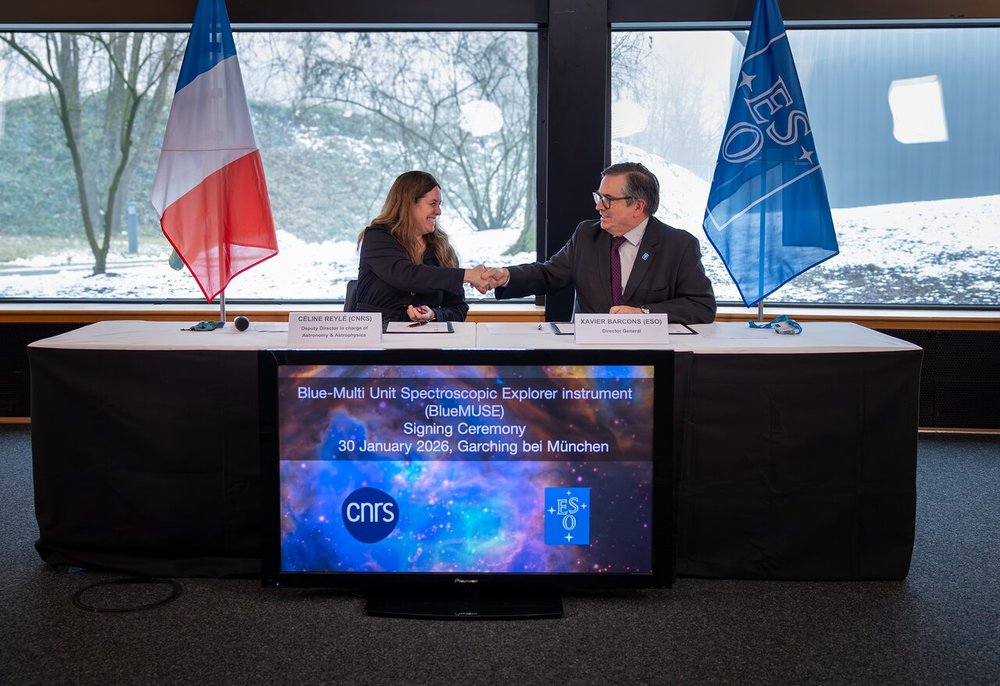
Céline Reylé, the Deputy Director for Science for Astronomy and Astrophysics at the French National Centre for Scientific Research (CNRS) and Xavier Barcons (Director General, ESO) sign the contract for BlueMUSE, an upcoming instrument for ESO’s Very Large Telescope (VLT)
Big screen size [1000 x 686, 130 KB]
Original size [1280 x 879, 200 KB]

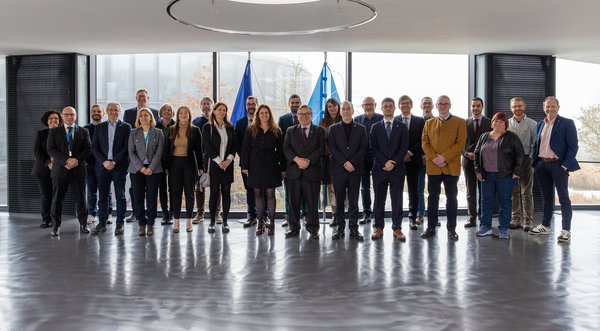
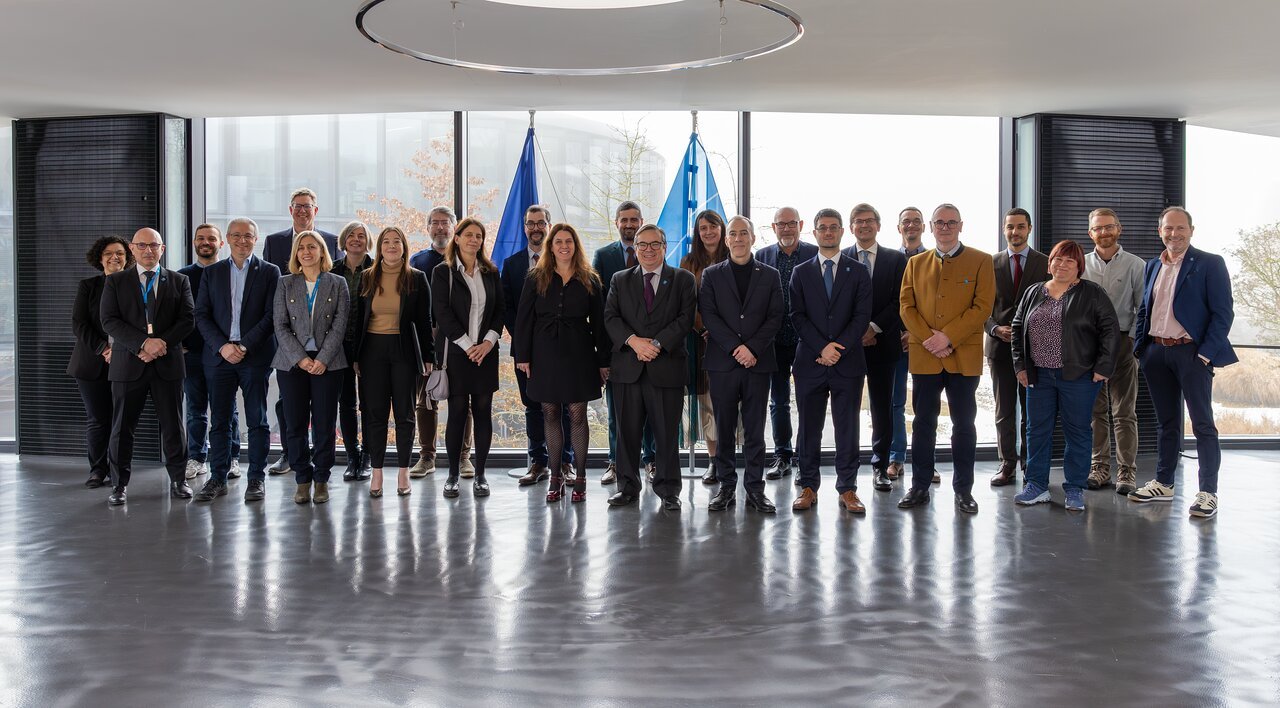
Participants at the signing ceremony for BlueMUSE, an upcoming instrument for ESO’s Very Large Telescope (VLT).
Big screen size [1000 x 553, 110 KB]
Original size [1280 x 708, 170 KB]
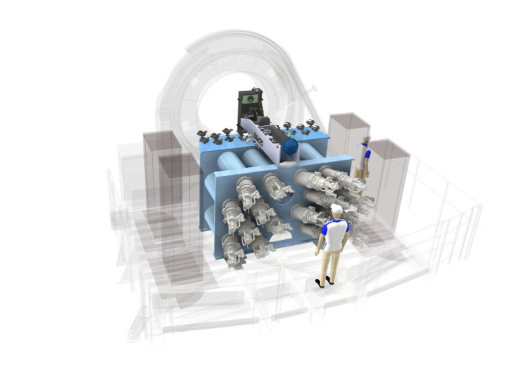
A computer-aided design illustrates the BlueMUSE instrument on the platform of the Very Large Telescope.