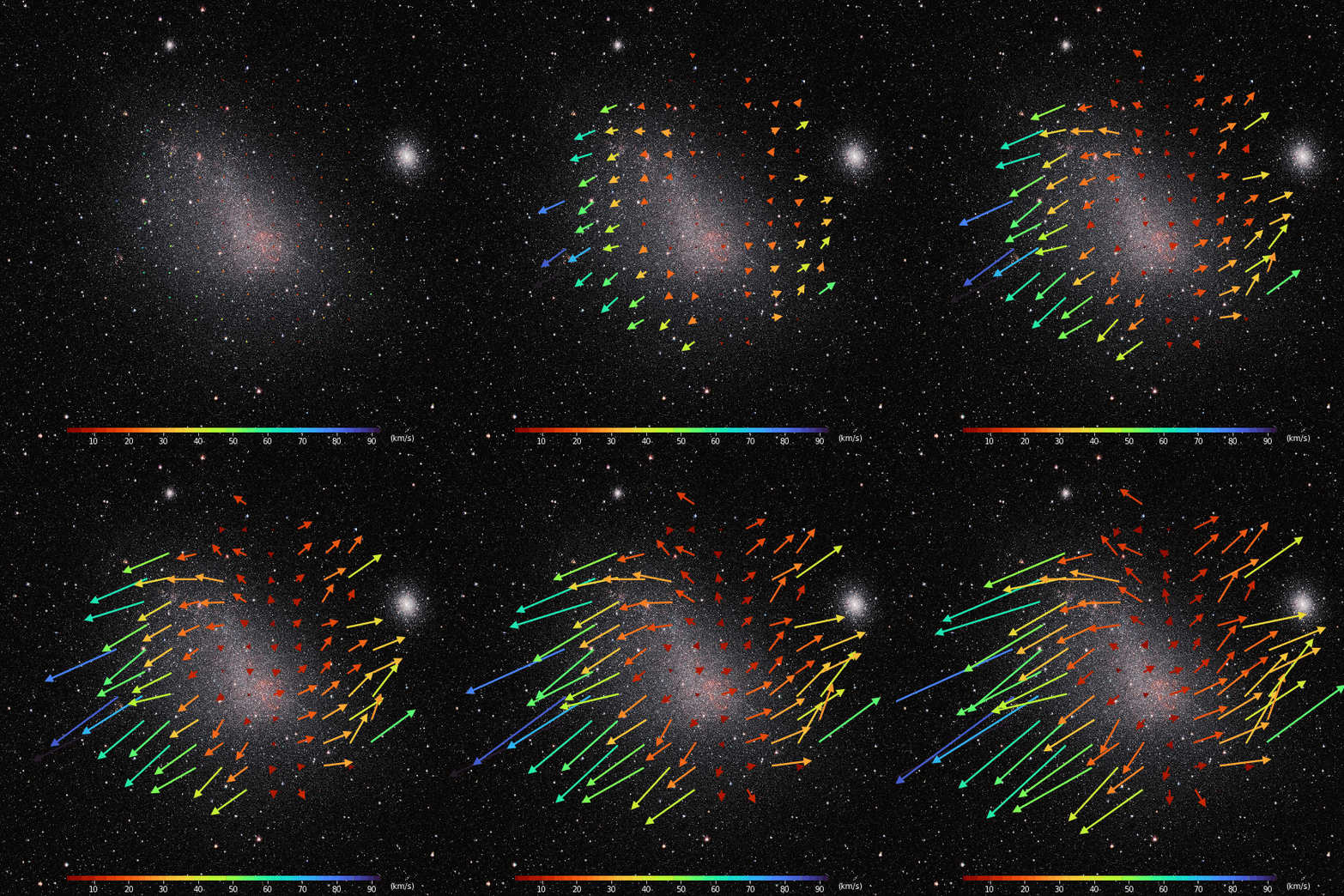
Galactic Neighbour caught strongly disturbed and expanding
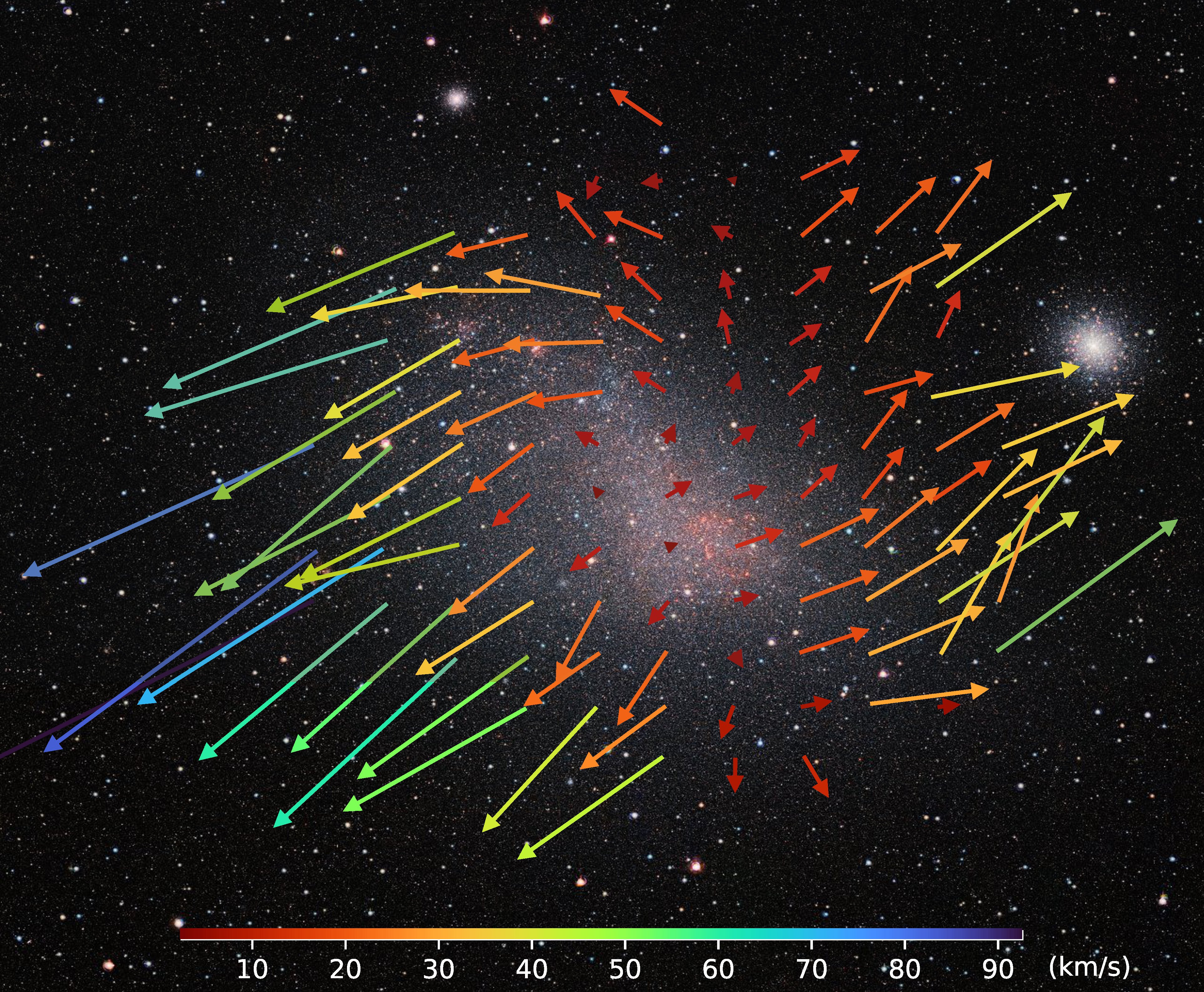
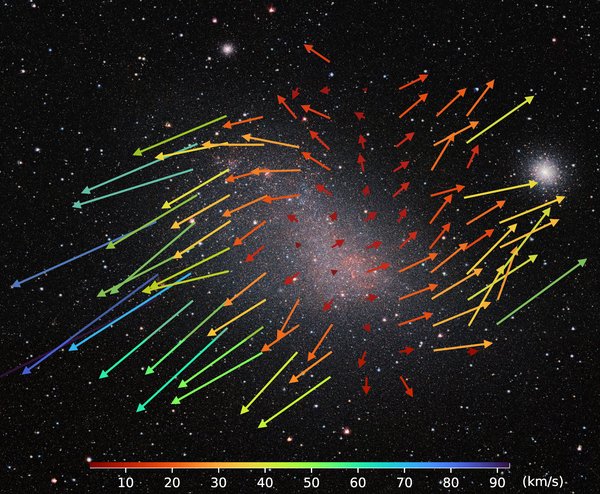
Small Magellanic Cloud observed with the VISTA Telescope. The arrows show the motion of stars away from the center of the galaxy, revealing a large-scale expansion pattern. The colour scale indicates the velocities of the stars.
Credit: ESO/VISTA VMC/ AIP/ S. VijayasreeNew stellar motion measurements reveal that the Small Magellanic Cloud is expanding and out of equilibrium due to interactions with the Large Magellanic Cloud. A new study presents the most detailed map yet of stellar motions, uncovering clear evidence that the nearby dwarf galaxy is being stretched and disrupted even in its central region by gravitational interactions from its larger neighbour.
Using more than a decade of observations from the VISTA Survey of the Magellanic Clouds (VMC), researchers measured the motions of millions of stars across the Small Magellanic Cloud with unprecedented precision. The new study, published in Astronomy & Astrophysics, provides direct evidence of a galaxy-wide tidal disruption of the Small Magellanic Cloud from its interaction with the Large Magellanic Cloud. Rather than showing coherent rotation typical of stable galaxies, stars across the Small Magellanic Cloud show large-scale outward motion, indicating the system is dynamically disturbed even in the inner regions.
“The results reveal large-scale tidal expansion throughout the Small Magellanic Cloud galaxy and challenge long-standing assumptions that the Small Magellanic Cloud behaves like a rotating disk,” says Sreepriya Vijayasree, doctoral student at the Leibniz Institute for Astrophysics Potsdam (AIP). “The study shows that the internal motions of stars in the Small Magellanic Cloud are dominated not by orderly rotation, but by gravitational disturbances caused by repeated encounters with the LMC over billions of years.”
The Small Magellanic Cloud is one of the Milky Way’s closest galactic neighbours, located about 200,000 light-years from Earth. Together with the Large Magellanic Cloud, it forms a pair of interacting satellite galaxies visible from the Southern Hemisphere. Because of their proximity, the Magellanic Clouds provide astronomers with a unique opportunity to study how galaxies evolve under the influence of gravity. Over time, interactions between the two galaxies have distorted their shapes, triggered bursts of star formation, and pulled streams of gas and stars into intergalactic space. The motions of stars preserve a record of these interactions. By tracking how stars move across the sky — known as “proper motions” — astronomers can reconstruct the dynamical history of the galaxy.
“The new study used observations from the VMC survey, an extensive near-infrared imaging programme conducted with the VISTA telescope at the European Southern Observatory’s Paranal Observatory in Chile” explains AIP researcher and principal investigator of the survey Prof. Dr. Maria-Rosa Cioni. “The VMC survey was designed to map the Magellanic Clouds in unprecedented detail in infrared light, allowing astronomers to peer through dust and study stellar populations spanning a wide range of ages. The latest VMC data release extends the observational time baseline to as much as 11 years, enabling much more precise measurements of stellar motions than earlier studies.” Dr. Florian Niederhofer, co-author of the study and postdoctoral researcher at AIP, adds: “When I saw the results for the first time, I was really amazed by the quality of the measured stellar motions. By combining observations that have been taken over a time baseline of more than a decade, we were able to map the internal kinematics of the Small Magellanic Cloud with a level of detail that is outstanding for observations from the ground.”
By analysing this long-time baseline, the team achieved a threefold improvement in proper-motion precision compared with previous VMC-based measurements. The resulting motion maps reveal that stars across the Small Magellanic Cloud are moving outward along a southeast–northwest axis — a signature consistent with tidal stretching caused by the gravitational pull of the Large Magellanic Cloud. The team found that stars in the Small Magellanic Cloud are moving outward with an average speed of about 17 kilometres per second. At this rate, stars can be displaced by several thousand light-years over a few hundred million years, enough to significantly distort the galaxy’s structure.
Remarkably, the expansion is visible not only in the galaxy’s outskirts but also deep within its central regions. The researchers found no evidence for coherent rotational motion once tidal effects were properly accounted for. Instead, the observed stellar motions are predominantly radial, indicating that the Small Magellanic Cloud is in a strongly disturbed dynamical state.
The findings suggest that commonly used rotating-disk models oversimplify the true complexity of the galaxy’s internal dynamics. According to the study, such models can mistakenly interpret tidal streaming motions as rotation. The study also uncovered a distinct northward stellar motion seen only among older red giant stars. This feature may preserve the imprint of an interaction that occurred more than two billion years ago. Younger and intermediate-age stars respond differently to the tidal forces, showing stronger and more coherent outward motions. This population-dependent behaviour indicates that the Small Magellanic Cloud’s stellar populations retain memory of different stages of the galaxy’s interaction history.
Further information
The letter was published in Astronomy & Astrophysics:
S. Vijayasree, F. Niederhofer, M.-R. L. Cioni, J. Th. van Loon, K. Bekki, R. de Grijs, S. Subramanian, N. Kacharov, A. O. Omkumar, L. R. Cullinane, and V. D. Ivanov (2026): The VMC survey – LV. The coherent expansion of the SMC, A&A, DOI:10.1051/0004-6361/202659431
Small Magellanic Cloud observed with the VISTA Telescope. The arrows show the motion of stars away from the center of the galaxy, revealing a large-scale expansion pattern. The colour scale indicates the velocities of the stars.
Credit: ESO/VISTA VMC/ AIP/ S. VijayasreeNew stellar motion measurements reveal that the Small Magellanic Cloud is expanding and out of equilibrium due to interactions with the Large Magellanic Cloud. A new study presents the most detailed map yet of stellar motions, uncovering clear evidence that the nearby dwarf galaxy is being stretched and disrupted even in its central region by gravitational interactions from its larger neighbour.
Using more than a decade of observations from the VISTA Survey of the Magellanic Clouds (VMC), researchers measured the motions of millions of stars across the Small Magellanic Cloud with unprecedented precision. The new study, published in Astronomy & Astrophysics, provides direct evidence of a galaxy-wide tidal disruption of the Small Magellanic Cloud from its interaction with the Large Magellanic Cloud. Rather than showing coherent rotation typical of stable galaxies, stars across the Small Magellanic Cloud show large-scale outward motion, indicating the system is dynamically disturbed even in the inner regions.
“The results reveal large-scale tidal expansion throughout the Small Magellanic Cloud galaxy and challenge long-standing assumptions that the Small Magellanic Cloud behaves like a rotating disk,” says Sreepriya Vijayasree, doctoral student at the Leibniz Institute for Astrophysics Potsdam (AIP). “The study shows that the internal motions of stars in the Small Magellanic Cloud are dominated not by orderly rotation, but by gravitational disturbances caused by repeated encounters with the LMC over billions of years.”
The Small Magellanic Cloud is one of the Milky Way’s closest galactic neighbours, located about 200,000 light-years from Earth. Together with the Large Magellanic Cloud, it forms a pair of interacting satellite galaxies visible from the Southern Hemisphere. Because of their proximity, the Magellanic Clouds provide astronomers with a unique opportunity to study how galaxies evolve under the influence of gravity. Over time, interactions between the two galaxies have distorted their shapes, triggered bursts of star formation, and pulled streams of gas and stars into intergalactic space. The motions of stars preserve a record of these interactions. By tracking how stars move across the sky — known as “proper motions” — astronomers can reconstruct the dynamical history of the galaxy.
“The new study used observations from the VMC survey, an extensive near-infrared imaging programme conducted with the VISTA telescope at the European Southern Observatory’s Paranal Observatory in Chile” explains AIP researcher and principal investigator of the survey Prof. Dr. Maria-Rosa Cioni. “The VMC survey was designed to map the Magellanic Clouds in unprecedented detail in infrared light, allowing astronomers to peer through dust and study stellar populations spanning a wide range of ages. The latest VMC data release extends the observational time baseline to as much as 11 years, enabling much more precise measurements of stellar motions than earlier studies.” Dr. Florian Niederhofer, co-author of the study and postdoctoral researcher at AIP, adds: “When I saw the results for the first time, I was really amazed by the quality of the measured stellar motions. By combining observations that have been taken over a time baseline of more than a decade, we were able to map the internal kinematics of the Small Magellanic Cloud with a level of detail that is outstanding for observations from the ground.”
By analysing this long-time baseline, the team achieved a threefold improvement in proper-motion precision compared with previous VMC-based measurements. The resulting motion maps reveal that stars across the Small Magellanic Cloud are moving outward along a southeast–northwest axis — a signature consistent with tidal stretching caused by the gravitational pull of the Large Magellanic Cloud. The team found that stars in the Small Magellanic Cloud are moving outward with an average speed of about 17 kilometres per second. At this rate, stars can be displaced by several thousand light-years over a few hundred million years, enough to significantly distort the galaxy’s structure.
Remarkably, the expansion is visible not only in the galaxy’s outskirts but also deep within its central regions. The researchers found no evidence for coherent rotational motion once tidal effects were properly accounted for. Instead, the observed stellar motions are predominantly radial, indicating that the Small Magellanic Cloud is in a strongly disturbed dynamical state.
The findings suggest that commonly used rotating-disk models oversimplify the true complexity of the galaxy’s internal dynamics. According to the study, such models can mistakenly interpret tidal streaming motions as rotation. The study also uncovered a distinct northward stellar motion seen only among older red giant stars. This feature may preserve the imprint of an interaction that occurred more than two billion years ago. Younger and intermediate-age stars respond differently to the tidal forces, showing stronger and more coherent outward motions. This population-dependent behaviour indicates that the Small Magellanic Cloud’s stellar populations retain memory of different stages of the galaxy’s interaction history.
Further information
The letter was published in Astronomy & Astrophysics:
S. Vijayasree, F. Niederhofer, M.-R. L. Cioni, J. Th. van Loon, K. Bekki, R. de Grijs, S. Subramanian, N. Kacharov, A. O. Omkumar, L. R. Cullinane, and V. D. Ivanov (2026): The VMC survey – LV. The coherent expansion of the SMC, A&A, DOI:10.1051/0004-6361/202659431
Images
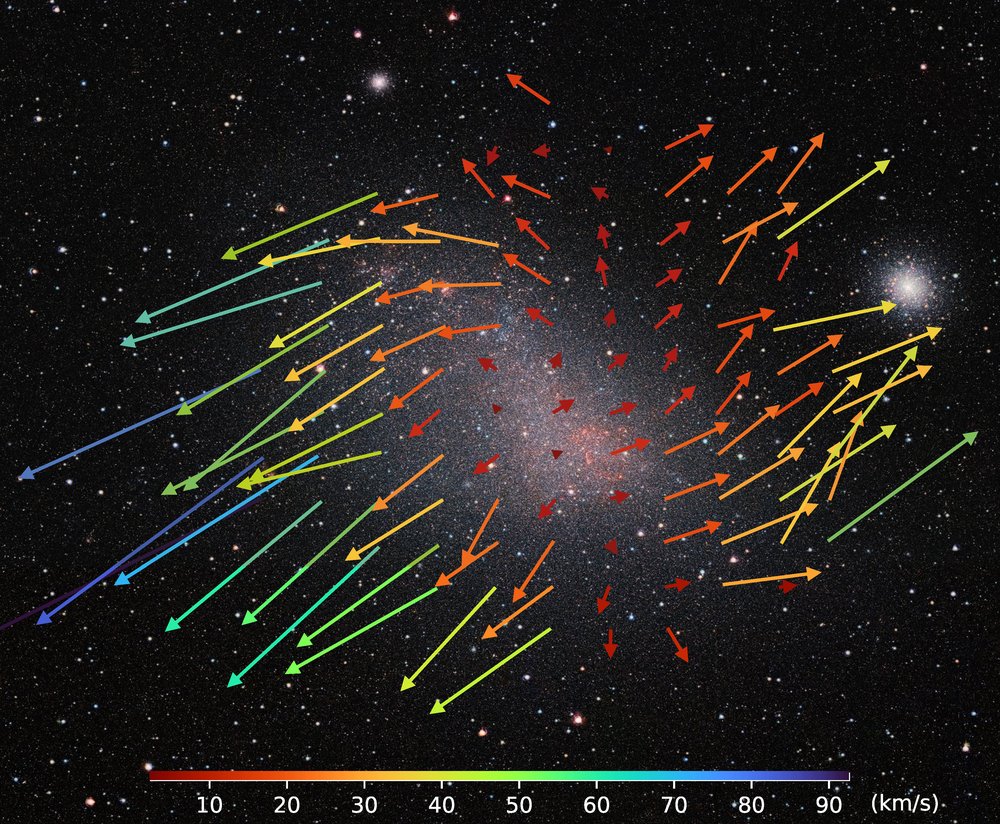
Small Magellanic Cloud observed with the VISTA Telescope. The arrows show the motion of stars away from the center of the galaxy, revealing a large-scale expansion pattern. The colour scale indicates the velocities of the stars.
Big screen size [1000 x 824, 250 KB]
Original size [3848 x 3171, 2.7 MB]
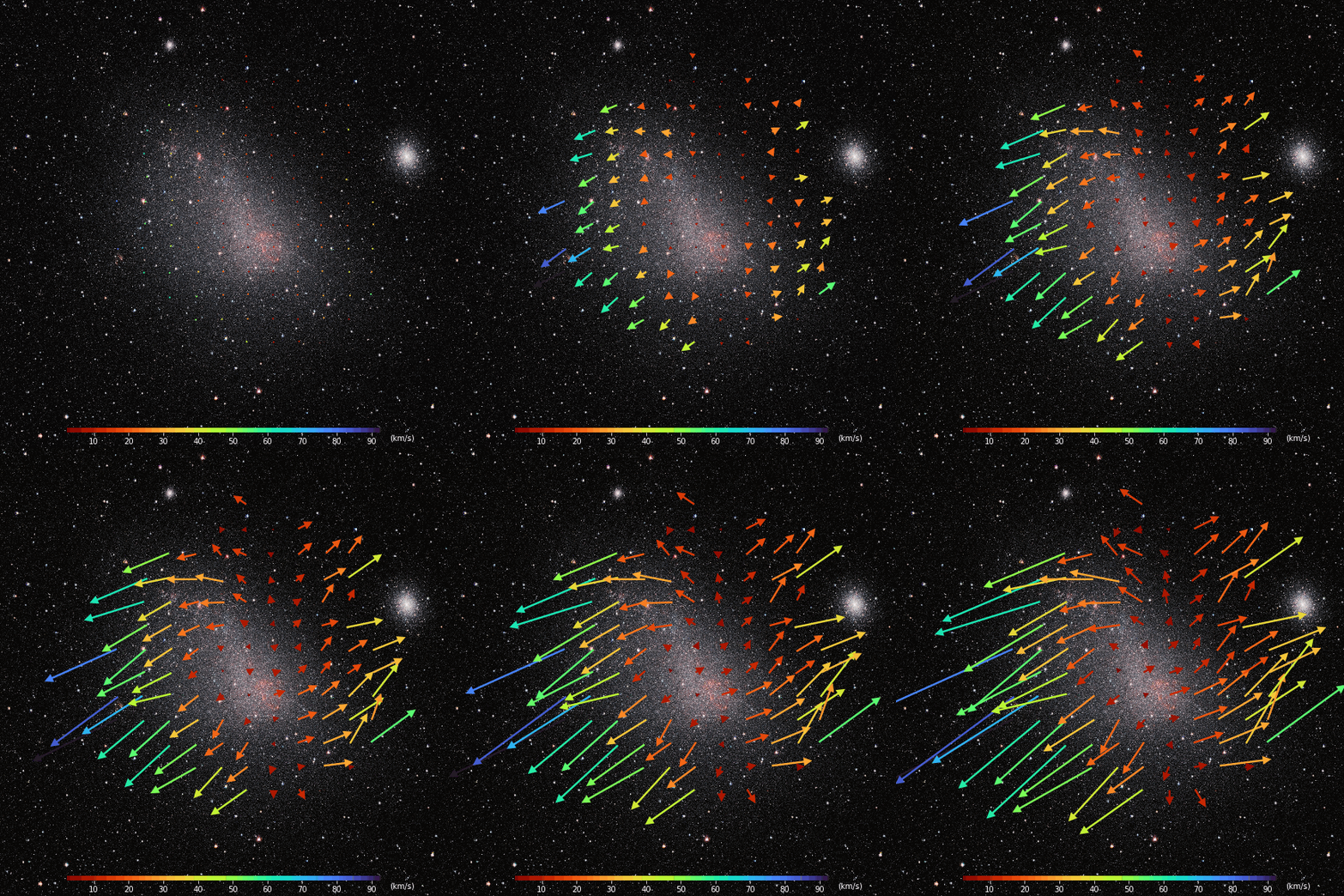
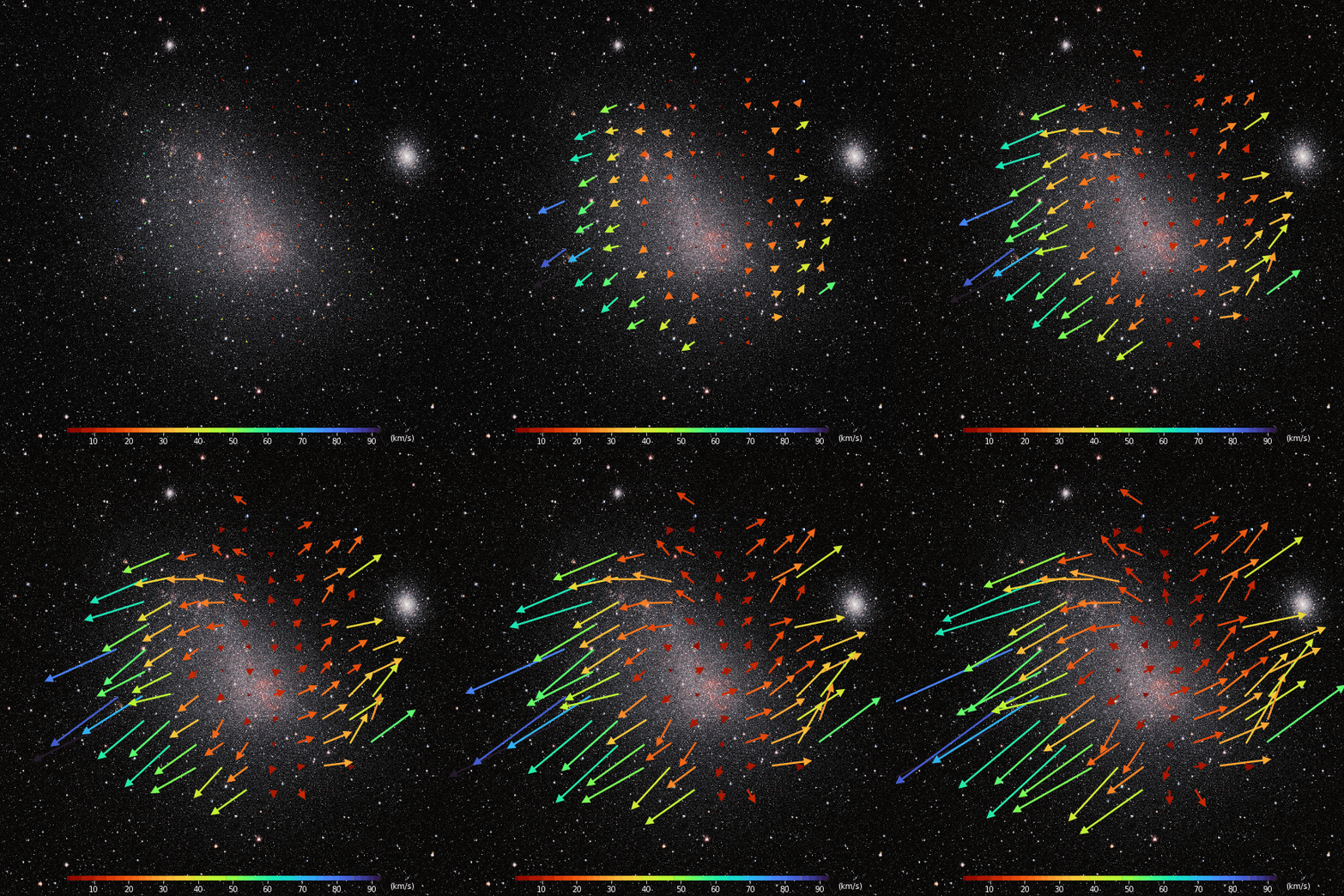
Animation of the arrows which show the motion of the stars in the Small Magellanic Cloud and thus its expansion.