Virtual Babelsberg Starry Night on 15th October 2026
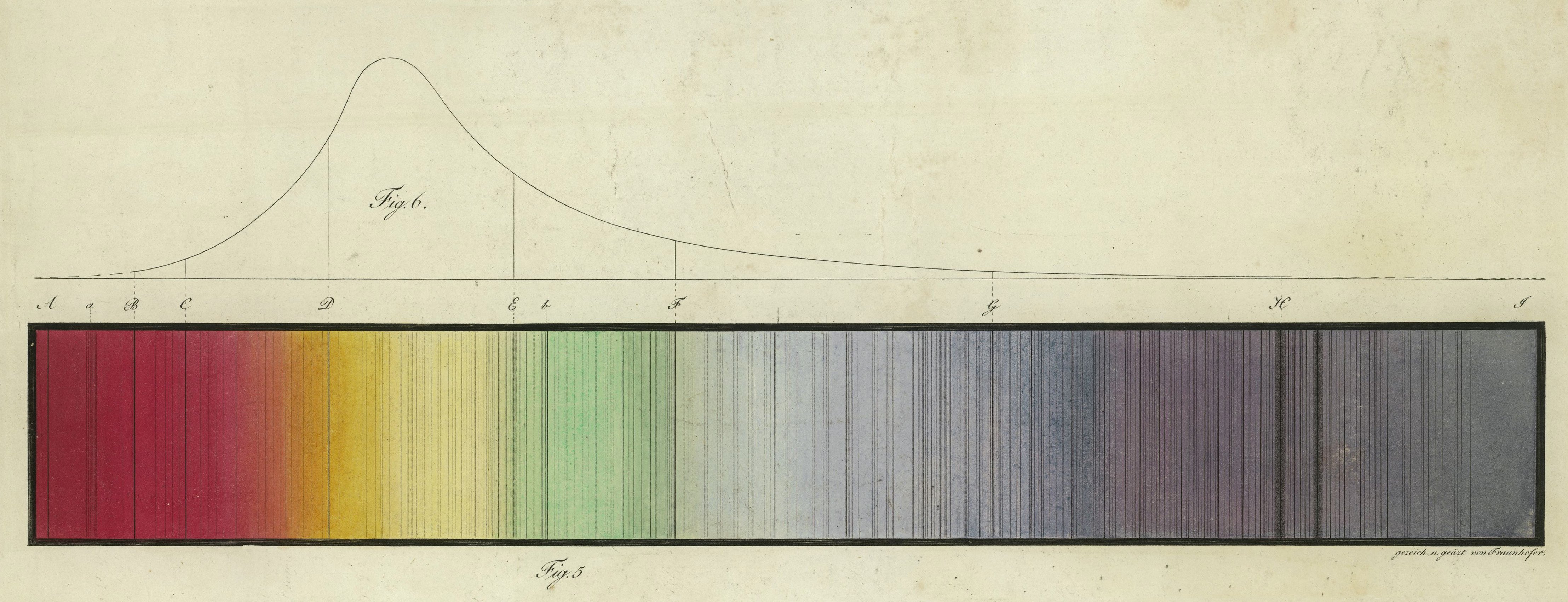
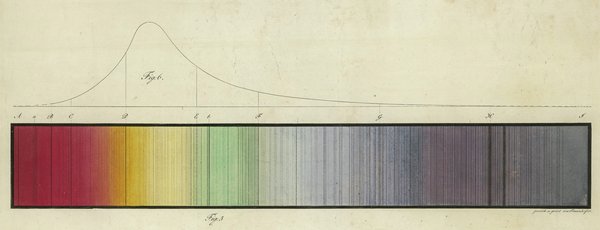
This image is a coloured etching by Joseph von Fraunhofer, showing the spectrum of sunlight with the dark Fraunhofer lines.
Credit: Deutsches Museum, Archiv, BN 43952On 15 October 2026, from 8.00 pm, a new talk by a researcher from the AIP will be published on the YouTube channel “Urknall, Weltall und das Leben” (Big Bang, Universe and Life): Dr Andreas Kelz speaks on “Spectral analysis as the foundation of modern astrophysics, or: The art of reading light” (in German).
Dr. Andreas Kelz is head of the Astronomical Spectroscopic Instrumentation research group at the AIP and specialises in the development of modern observational instruments that split light into its spectral colours. In his lecture, delivered live at the DLR Astroseminar 2026, he provides a brief overview of the history and physics of spectral analysis. He presents some of the historical instruments and their applications, right up to the modern large-scale instruments used for current scientific research topics in galactic and extragalactic astrophysics.
The video will be published at 8 p.m. on the YouTube channel Urknall, Weltall und das Leben (Big Bang, Space and Life).
Usually on the 3rd Thursday of each month, starting at 8 p.m., the lectures of the Babelsberg Starry Nights become available at
https://www.aip.de/babelsberger-sternennaechte
and via the YouTube channels "Urknall, Weltall und das Leben" (Big Bang, Universe and Life) and "videowissen" and can be viewed afterwards at any time.
Further information
For everyone in the Potsdam-Berlin region, there is another highlight on Thursday 15 October 2026: a live public lecture by Prof. Dr Matthias Steinmetz on ‘The Construction of the Extremely Large Telescope (ELT)’ (in German), held at the AIP in Babelsberg. The event starts at 7.15 pm, followed by an opportunity to observe the sky through one of the (historic) telescopes in Babelsberg.
This image is a coloured etching by Joseph von Fraunhofer, showing the spectrum of sunlight with the dark Fraunhofer lines.
Credit: Deutsches Museum, Archiv, BN 43952On 15 October 2026, from 8.00 pm, a new talk by a researcher from the AIP will be published on the YouTube channel “Urknall, Weltall und das Leben” (Big Bang, Universe and Life): Dr Andreas Kelz speaks on “Spectral analysis as the foundation of modern astrophysics, or: The art of reading light” (in German).
Dr. Andreas Kelz is head of the Astronomical Spectroscopic Instrumentation research group at the AIP and specialises in the development of modern observational instruments that split light into its spectral colours. In his lecture, delivered live at the DLR Astroseminar 2026, he provides a brief overview of the history and physics of spectral analysis. He presents some of the historical instruments and their applications, right up to the modern large-scale instruments used for current scientific research topics in galactic and extragalactic astrophysics.
The video will be published at 8 p.m. on the YouTube channel Urknall, Weltall und das Leben (Big Bang, Space and Life).
Usually on the 3rd Thursday of each month, starting at 8 p.m., the lectures of the Babelsberg Starry Nights become available at
https://www.aip.de/babelsberger-sternennaechte
and via the YouTube channels "Urknall, Weltall und das Leben" (Big Bang, Universe and Life) and "videowissen" and can be viewed afterwards at any time.
Further information
For everyone in the Potsdam-Berlin region, there is another highlight on Thursday 15 October 2026: a live public lecture by Prof. Dr Matthias Steinmetz on ‘The Construction of the Extremely Large Telescope (ELT)’ (in German), held at the AIP in Babelsberg. The event starts at 7.15 pm, followed by an opportunity to observe the sky through one of the (historic) telescopes in Babelsberg.
Images
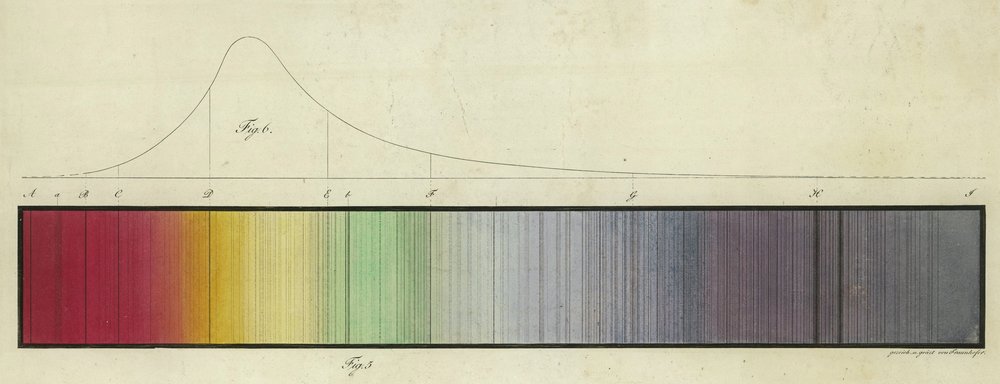
This image is a coloured etching by Joseph von Fraunhofer, showing the spectrum of sunlight with the dark Fraunhofer lines.
Big screen size [1000 x 384, 50 KB]
Original size [4431 x 1702, 1.2 MB]