The X-ray sky comes into focus – eROSITA-DE releases its second collection of public source catalogues
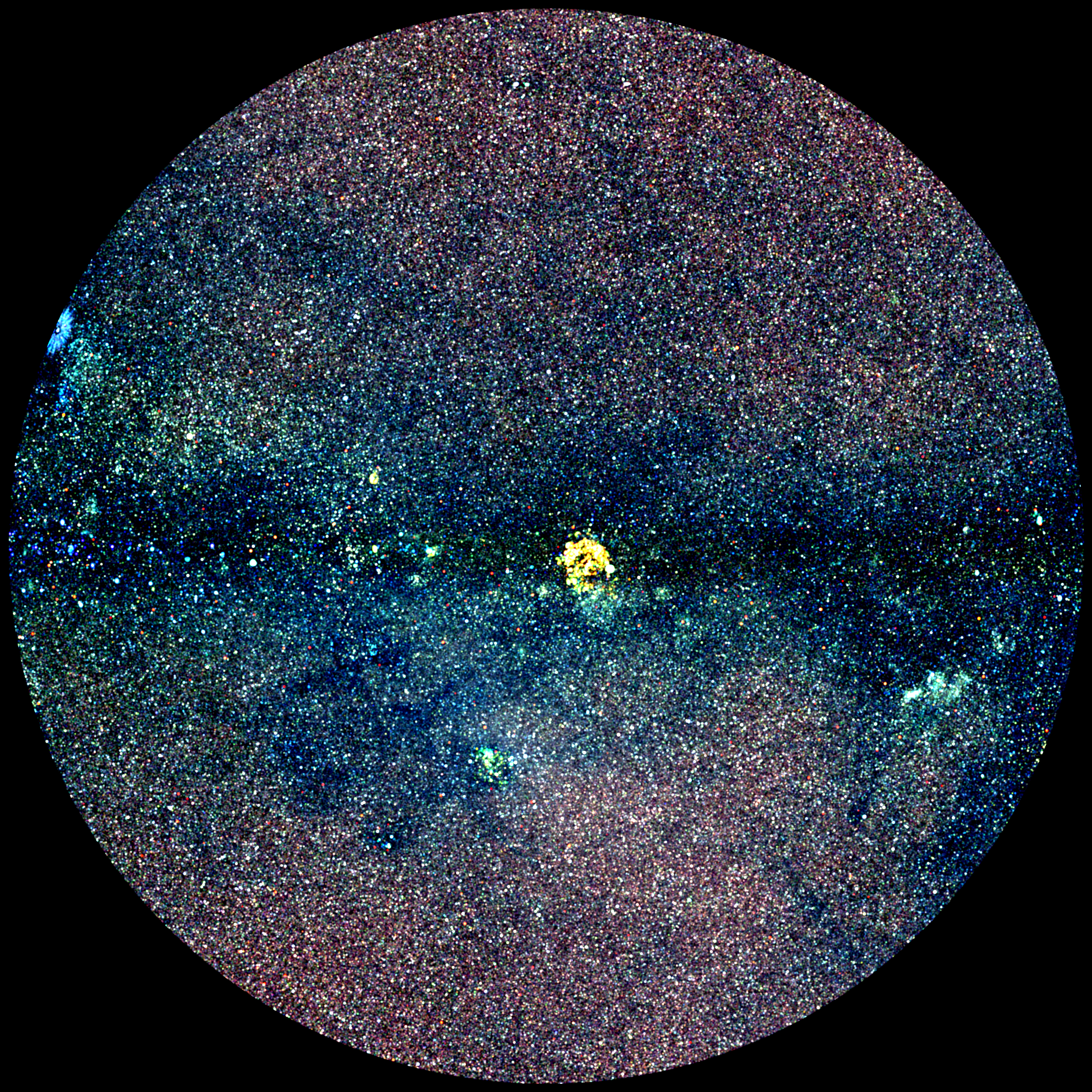
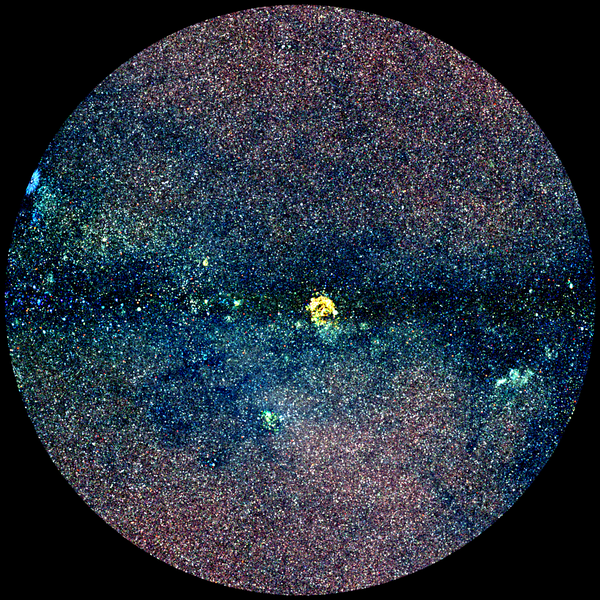
The colour image shows X-ray sources in the western hemisphere of the X-ray sky. The Galactic plane lies horizontally through the centre of the image. Sources in the eROSITA catalogue are plotted with their red, green and blue brightness showing their count rate in soft (0.5-1.0 keV), medium (0.5-1.0 keV) and hard (1.0-2.0 keV), respectively. The sky is plotted using an azimuthal equal area projection.
Credit: MPE, J. Sanders für das eROSITA-KonsortiumThe German eROSITA Consortium (eROSITA-DE), with the participation of the Leibniz Institute for Astrophysics Potsdam (AIP), has released its second major public dataset, eROSITA Data Release 2 (DR2). Built from the first three all-sky scans of the eROSITA telescope aboard the Spectrum-Roentgen-Gamma (SRG) mission, DR2 provides the most sensitive and comprehensive catalogue of the X-ray sky currently available to the public.
The main DR2 catalogue contains close to two million X-ray sources detected in the 0.2–2.3 keV energy band across the western half of the sky. This includes more than 1.9 million point-like sources, primarily stars and actively accreting supermassive black holes, as well as around 64,000 extended sources, such as galaxy clusters, nearby galaxies, and supernova remnants. Compared to the first data release in 2024, the number of detected sources has roughly doubled. A separate hard-band catalogue adds nearly 15,000 sources detected at higher energies (2.3–5.0 keV). These sources trace highly energetic systems whose lower-energy X-ray emission is heavily absorbed.
"Each additional scan allows us to uncover sources that were previously below the detection threshold," says Miriam E. Ramos-Ceja, Ground Segment manager of the eROSITA instrument and lead author of the DR2 publication. "By combining three surveys, DR2 provides a much more complete inventory of the X-ray sky and a robust foundation for statistical studies."
As one of the core institutes of the German eROSITA Consortium, the Leibniz Institute for Astrophysics Potsdam (AIP) has once again made key contributions to data processing and scientific analysis. At AIP, the methods for the reliable identification of X-ray sources have been continuously refined. In addition, AIP is responsible for the Upper Limit Service, which allows researchers to determine, for any position on the sky, the maximum X-ray brightness of a source that would have remained undetected by eROSITA. Such sensitivity information is essential for statistically accounting for non-detections and for reliably comparing known or newly discovered astronomical objects with the eROSITA data. The Upper Flux Limit Value Added Catalogue (VAC) is therefore one of the key value-added products of the second data release.
"With DR2, we are now providing the scientific community with an exceptionally powerful dataset," says Andrea Merloni, eROSITA Project Scientist at the Max Planck Institute for Extraterrestrial Physics (MPE) in Garching. Axel Schwope, eROSITA Project Scientist at AIP, adds: "From rare objects to large-scale population studies, DR2 will shape X-ray astronomy for years to come."
"The combination of the large number of newly discovered sources, the improved data quality, and the analysis tools developed at AIP opens up tremendous scientific opportunities," says Georg Lamer of AIP, who played a leading role in developing and adapting the eROSITA data-processing software.
The release of eROSITA DR2 coincides with the twentieth data release of the Sloan Digital Sky Survey (SDSS DR20), which includes extensive spectroscopic data for eROSITA sources. Together, these datasets represent the culmination of nearly a decade of collaboration between the German eROSITA Consortium and the SDSS collaboration.
The scientific potential of these data is already demonstrated by the ten papers accompanying the data release, two of which were led by researchers at AIP (Brink et al.; Schwope et al.). One of these studies, carried out within a broad international collaboration, presents the largest sample to date of compact interacting binary systems undergoing mass transfer between the two stars ("cannibal stars"). These systems are thought to be responsible for the faint diffuse X-ray glow of the Milky Way's Galactic disc.
Since the start of scientific operations in December 2019, eROSITA has surveyed the entire sky every six months. For the present data release, the first three all-sky surveys were combined, enabling the detection of significantly fainter sources than in the first public data release. The new data nearly double the number of known X-ray sources and provide the worldwide scientific community with new opportunities to explore the high-energy Universe.
Further information
Images
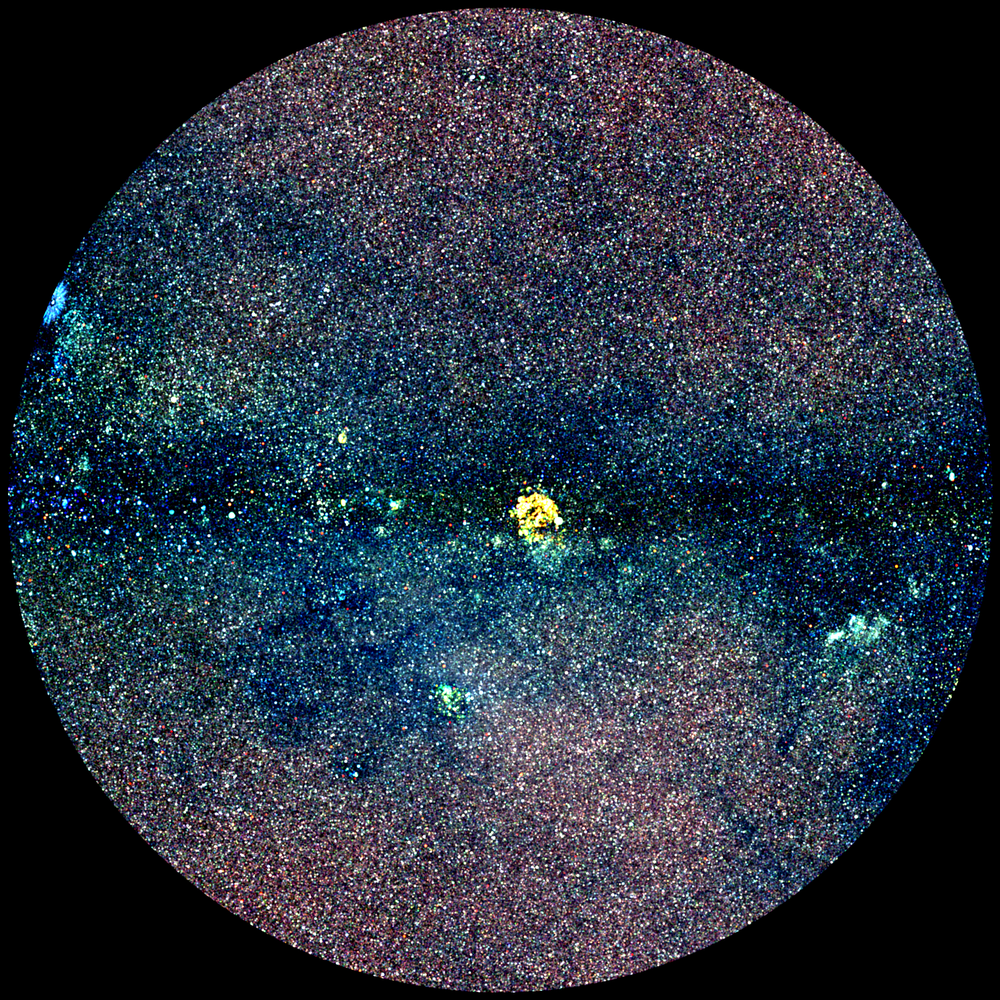
The colour image shows X-ray sources in the western hemisphere of the X-ray sky. The Galactic plane lies horizontally through the centre of the image. Sources in the eROSITA catalogue are plotted with their red, green and blue brightness showing their count rate in soft (0.5-1.0 keV), medium (0.5-1.0 keV) and hard (1.0-2.0 keV), respectively. The sky is plotted using an azimuthal equal area projection.
Big screen size [1000 x 1000, 2.0 MB]
Original size [1872 x 1872, 6.0 MB]
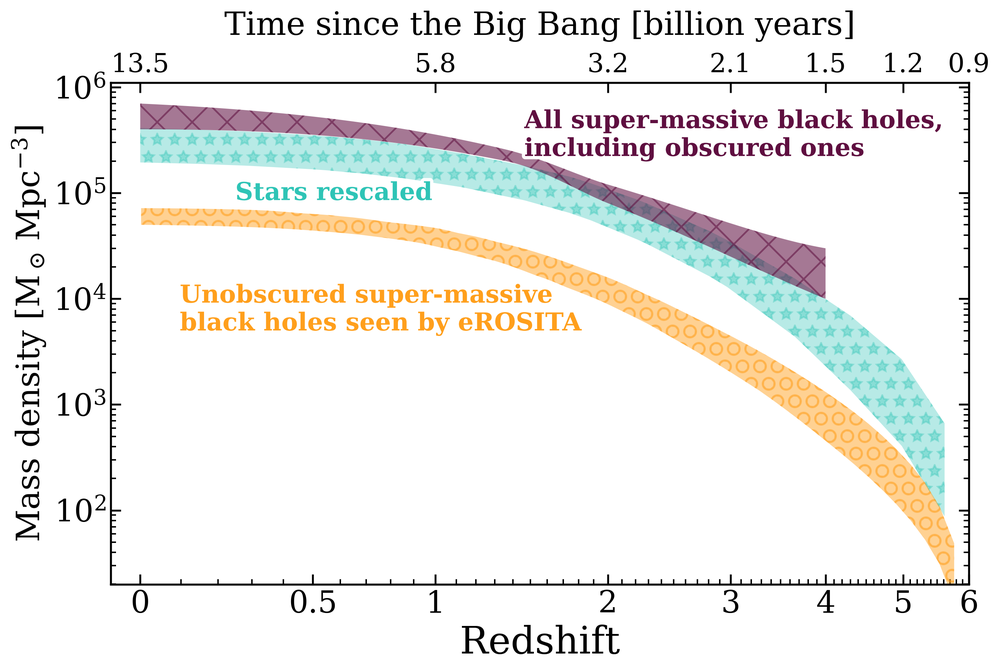
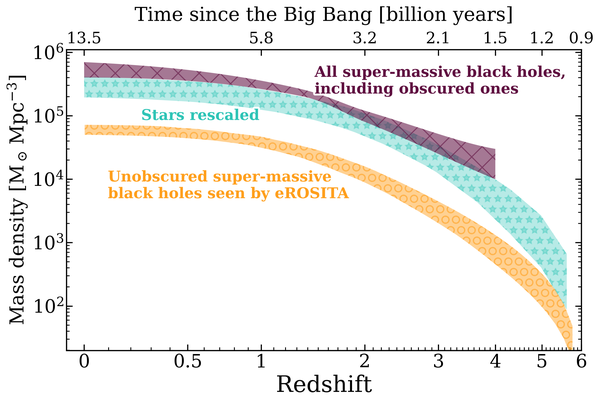
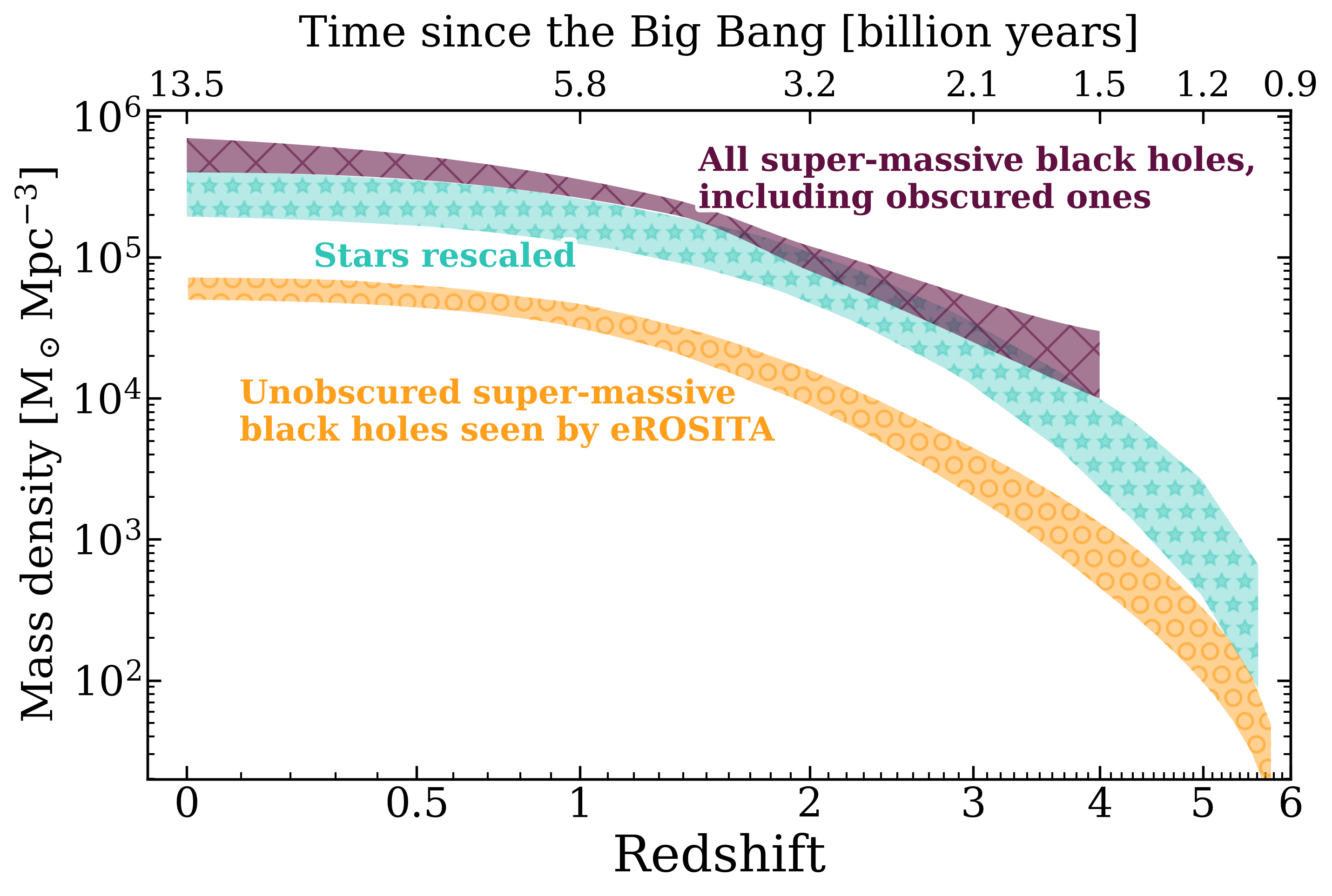
This figure compares the build-up of mass locked in super-massive black holes with the rescaled growth of the stellar population in inactive galaxies over cosmic time. The eROSITA X-ray census traces the fraction of super-massive black hole growth that is directly visible in the soft X-rays, while estimates including obscured sources show that much of the total growth is hidden from this view. The gap implies that roughly 70-90% of super-massive black holes' growth likely occurred in soft X-ray-suppressed phases. The shape similarity of all growth curves supports the claim that accreting super-massive black holes and galaxies evolved in lockstep, growing over broadly similar cosmic epochs.
Big screen size [1000 x 672, 260 KB]
Original size [2862 x 1926, 430 KB]