Virtual lecture: Babelsberg Starry Night on 17th September 2026
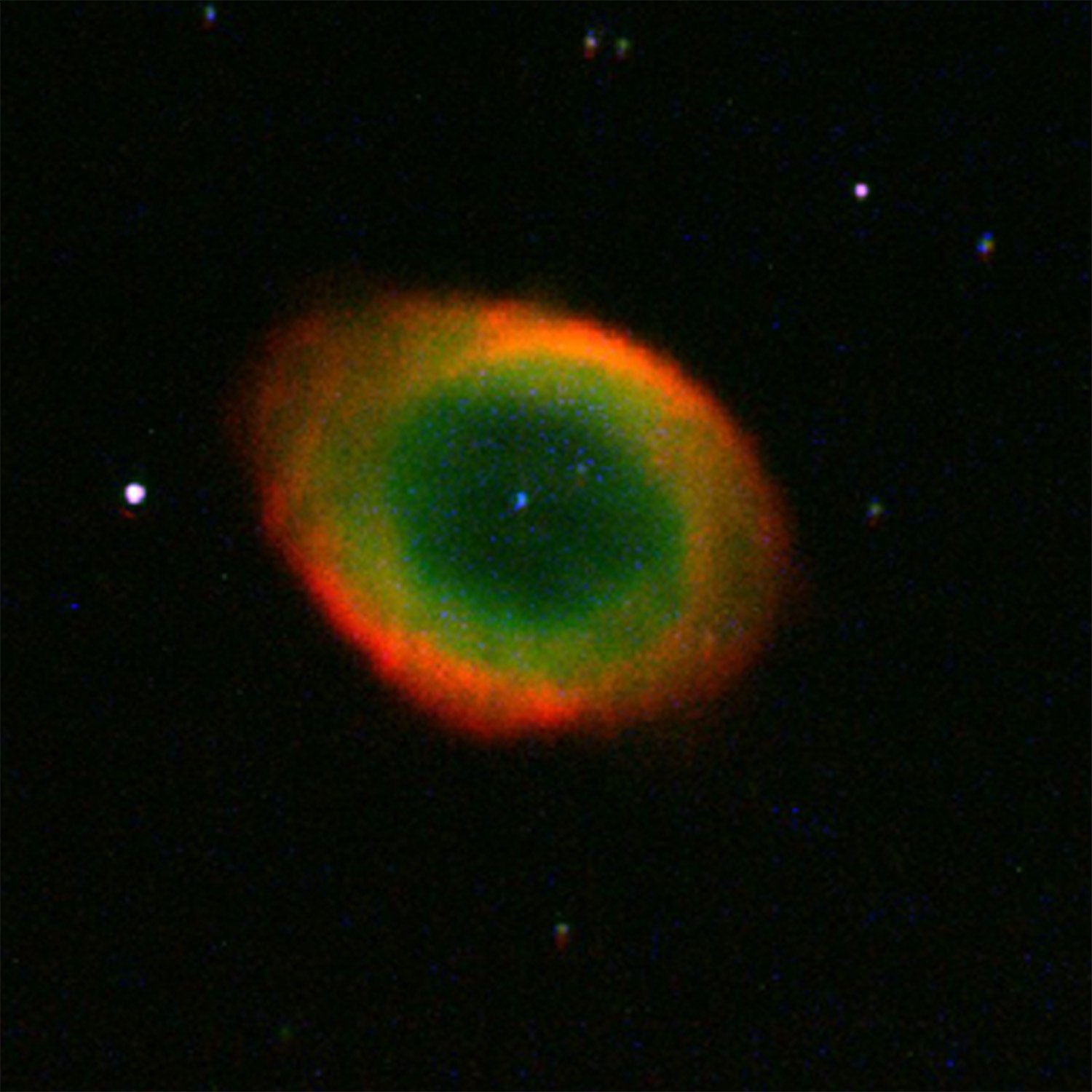
This image of the planetary nebula M57 was taken using a new type of camera based on a silicon CMOS chip developed by the German Centre for Astrophysics.
Credit: DZAIn the next lecture in the Virtual Babelsberg Starry Nights’ series of the Leibniz Institute for Astrophysics Potsdam, entitled ‘From Carbon to Silicon’, Prof. Dr Martin Roth will discuss astronomy, spectroscopy, semiconductor technology and new developments at the German Centre for Astrophysics (DZA). The video of the lecture will be available from Thursday, 17th September 2026, on the YouTube channel “Urknall, Weltall und das Leben” (Big Bang, Universe and Life).
Prof. Dr Martin Roth conducts research at the AIP in the Astrophotonics group, as well as at the German Centre for Astrophysics (DZA), which is currently being established in Lusatia. His lecture, ‘From Carbon to Silicon’, explores the use of high-purity silicon for observational astronomy in the optical spectral range – symbolizing the transition from an economy based on coal mining to a silicon-based semiconductor industry. In the context of astronomy, the focus is put on semiconductor image sensors. A major shift is currently taking place here: the technology of silicon-based CCD detectors, which has dominated since the 1980s, is now being replaced by that of CMOS image sensors, which are also made from silicon but are based on a process that is easier for the industry to master.
As an example, the use of a novel, particularly high-performance CMOS image sensor for time-resolved photometry is discussed. This sensor has been installed on a telescope as part of a pilot project by the recently founded German Centre for Astrophysics. The talk concludes with an outlook on future research relating to the observation of merger processes involving compact objects and black holes, which are detected by gravitational-wave detectors.
The video will be published at 8 p.m. on the YouTube channel Urknall, Weltall und das Leben (Big Bang, Space and Life).
Usually on the 3rd Thursday of each month, starting at 8 p.m., the lectures of the Babelsberg Starry Nights become available at
https://www.aip.de/babelsberger-sternennaechte
and via the YouTube channels "Urknall, Weltall und das Leben" (Big Bang, Universe and Life) or "videowissen" and can be viewed afterwards at any time.
This image of the planetary nebula M57 was taken using a new type of camera based on a silicon CMOS chip developed by the German Centre for Astrophysics.
Credit: DZAIn the next lecture in the Virtual Babelsberg Starry Nights’ series of the Leibniz Institute for Astrophysics Potsdam, entitled ‘From Carbon to Silicon’, Prof. Dr Martin Roth will discuss astronomy, spectroscopy, semiconductor technology and new developments at the German Centre for Astrophysics (DZA). The video of the lecture will be available from Thursday, 17th September 2026, on the YouTube channel “Urknall, Weltall und das Leben” (Big Bang, Universe and Life).
Prof. Dr Martin Roth conducts research at the AIP in the Astrophotonics group, as well as at the German Centre for Astrophysics (DZA), which is currently being established in Lusatia. His lecture, ‘From Carbon to Silicon’, explores the use of high-purity silicon for observational astronomy in the optical spectral range – symbolizing the transition from an economy based on coal mining to a silicon-based semiconductor industry. In the context of astronomy, the focus is put on semiconductor image sensors. A major shift is currently taking place here: the technology of silicon-based CCD detectors, which has dominated since the 1980s, is now being replaced by that of CMOS image sensors, which are also made from silicon but are based on a process that is easier for the industry to master.
As an example, the use of a novel, particularly high-performance CMOS image sensor for time-resolved photometry is discussed. This sensor has been installed on a telescope as part of a pilot project by the recently founded German Centre for Astrophysics. The talk concludes with an outlook on future research relating to the observation of merger processes involving compact objects and black holes, which are detected by gravitational-wave detectors.
The video will be published at 8 p.m. on the YouTube channel Urknall, Weltall und das Leben (Big Bang, Space and Life).
Usually on the 3rd Thursday of each month, starting at 8 p.m., the lectures of the Babelsberg Starry Nights become available at
https://www.aip.de/babelsberger-sternennaechte
and via the YouTube channels "Urknall, Weltall und das Leben" (Big Bang, Universe and Life) or "videowissen" and can be viewed afterwards at any time.