Konferenzen-Archiv

Hier finden Sie einige zurückliegende Konferenzen, insbesondere Thinkshops der letzten Jahre. Diese Liste ist nicht vollständig.

thinkshop6.jpg

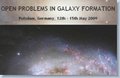
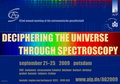
Open Problems in Galaxy Formation

6th Thinkshop 2009
12. Mai 2009 – 15. Mai 2009

The formation of galaxies is the result of the complex interaction of many different processes. Observations at different frequencies trace different galactic constituents, while semianalytic models of galaxy formation are an attempt to combine these different aspects into a coherent picture of galaxy formation in a cosmological context. Theoretical arguments and hydrodynamic simulations have brought a new comprehension of the way galaxies accrete and cease to accrete gas. These developments have also renewed interest for some key open problems in galaxy formation: the link between stellar populations and dynamical evolution, the formation of massive star forming galaxies at high redshift, the formation of discs, and the thermal and chemical evolution of the intergalactic and intracluster medium. The workshop "Open Problems In Galaxy Formation" will bring together the different perspectives of theorists and observers from all wavelengths in order to identify the outstanding problems where we can make substantial progress in the next five years, also thanks to new observing facilities such as MUSE, ALMA, and the JWST, and to promote a closer collaboration between theory and observations.

Mercure Hotel, Potsdam, Germany

palmcove.jpeg

Overcoming Great Barriers in Galactic Archaeology

AAO Workshop
5. Mai 2009 – 8. Mai 2009

This workshop of the AAO, the AIP, the ANU, and the University of Sydney will discuss the study of the history of our Milky Way Galaxy and the Local Group using large-scale surveys of the velocities and physical parameters of stars. What was the sequence and process of formation of the Galaxy? What can we learn from substructures identified in the disc and halo of our Galaxy? How do galactic bulges form? Can we find examples of the first stars in our Galaxy, and how do they relate to the formation of the metal-poor galactic halo? How is the chemistry of stars related to their ages? And, most fundamentally, what can our Galaxy tell us about the validity of our cosmological standard model (and thus the nature of dark matter and dark energy) on small scales? The workshop will also have the pleasant additional function of celebrating the contributions of Professors Mike Bessell and John Norris of the Australian National University.

Palm Cove, Queensland, Australia

iaus259_web.jpg

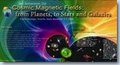
IAUS 259: Cosmic Magnetic Fields: from Planets, to Stars and Galaxies

IAU Symposium
3. November 2008 – 7. November 2008

Magnetic fields in star-forming regions; the multi-scale field of the Sun and its interior; the Jupiter-Io system; heliospheric and interplanetary fields; Earth's magnetic field; surface fields of cool and hot stars and of degenerate objects; planetary-nebulae shaping by magnetic fields, jet and accretion-disk fields: from stars to AGNs and beyond; fields around stellar black holes and magnetars, Supernovae, the magnetic field of the galactic center; the galactic field; fields of spiral galaxies; instrumentation and techniques for measuring magnetic fields across all wavelengths, from the ground and space, with emphasis on soon-to-come facilities (optical, IR, FIR/sub-mm, radio).

Puerto Santiago, Tenerife, Spain

rhessi_workshop.jpeg

8th RHESSI Workshop

2. September 2008 – 6. September 2008

RHESSI is a NASA Small Explorer Mission dedicated to the study of particle acceleration and explosive energy release in solar flares. The satellite was launched by a Pegasus rocket into a low earth orbit on February 5, 2002. The 8th RHESSI Workshop will take place at the Astrophysical Institute Potsdam (AIP), situated in the Babelsberg suburb of Potsdam, Germany, on September 2-6, 2008. The event is being organized by the AIP Solar Radio Group.

AIP, Potsdam, Germany

IFUposter.gif

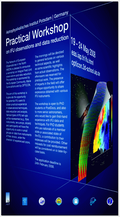
The NEON 3D Spectra School: First Practical Workshop on IFU Observations and Data Reduction

19. Mai 2008 – 24. Mai 2008

The Network of European Observatoires in the North is pleased to announce a workshop on Integral Field Unit observations and data reduction. The aim is to provide the opportunity for potential IFU users to obtain practical experience in observational techniques, data reduction and analysis. Various types of IFU set-ups will be represented (e.g., fibre instruments, lens arrays, slicers) and participants will have the opportunity to work in small groups on data from instruments of their choice, under the direction of experienced tutors.

AIP, Potsdam, Germany

Splinter meeting (AG): LBT instrumentation and key-science projects

Annual Meeting of the Astronomische Gesellschaft (AG)
25. September 2007 – 26. September 2007

The splinter meeting includes sessions on LBT instrumentation, key science projects, and future exploitation of the LBT.

Würzburg, Germany

ARENA Conference: The Astrophysical Science Cases at Dome C

17. September 2007 – 21. September 2007

This 2nd Conference is essentially dedicated to identify and consolidate the best science cases that would motivate the implementation of a world class astronomical observatory in Antarctica based at the CONCORDIA station on Dome C which offers unique ground-based atmospheric conditions to achieve observations that would normally only be possible in space. The conference will emphasize the scientific areas of astrophysics in which Antarctic conditions would provide unique new data not otherwise obtainable neither from ground nor space.

Fokusseminar Faserspektroskopie und Sensorik

31. August 2007

innoFSPEC Potsdam steht für "Innovative Faserspektroskopie und Sensorik". Es ist ein Gemeinschaftsvorhaben des Astrophysikalischen Instituts Potsdam und der Universität Potsdam. Mit dem Fokusseminar soll der interdisziplinäre Dialog zwischen den System- und Komponentenentwicklern sowie den Nutzern im Bereich der Faserspektroskopie und Sensorik befördert werden.

Potsdam, Germany

thinkshop5.jpg

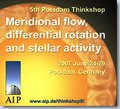
Meridional flow, differential rotation, solar and stellar activity

5th Thinkshop 2007
24. Juni 2007 – 29. Juni 2007

Meridional flow and its connection to the differential rotation are our main topics as well as magnetic stars, the stability of magnetic fields, and dynamo problems. Observational issues cover helio- and asteroseismology, indirect imaging, and stellar activity surveys. Our current understanding of the magnetohydrodynamics of the solar and stellar interiors shall be discussed, from both a theoretical and an observational point of view.

Potsdam, Germany

ARENA Workshop: Telescope and Instrumentation Robotization at Dome C

26. März 2007 – 29. März 2007

The aim of the meeting is to bring together active researchers and technicians as well as the Concordia station operators and logistic teams to discuss and establish the general conditions for successful implementation and future operation of robotic telescopes and instrumentation at Dome C. A lively exchange of thoughts is inherent to the ARENA "Workshop" idea and is driven by the scientific projects tailored to the unique capabilities of Dome C as well as to the technical limitations of reasonable robotic operation.

8th MHD Days

28. November 2006 – 29. November 2006
thinkshop4.jpg

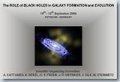
The role of black holes in galaxy formation and evolution

4th Thinkshop 2006
10. September 2006 – 13. September 2006

The discovery that many nearby galaxies contain supermassive black holes and that the black hole mass is proportional to the mass of the host galaxy has stimulated an intense research activity to understand the growth of supermassive black holes in a cosmological perspective. This conference of the Potsdam Thinkhop Series will bring together scientists from both the galaxy formation and the active galactic nucleus community to make a coherent picture emerge.

IAU General Assembly - Joint Discussion 8 "Solar and Stellar Activity Cycles"

IAU General Assembly
17. August 2006 – 18. August 2006

Topics include solar activity cycle in the interior, atmosphere and corona; observations of stellar magnetic activity and cycles; and the solar-stellar connections and theories.

Prague, Czech Republic

6th Helmholtz Institute Summer School - Supercomputational Cosmology

17. Juli 2006 – 21. Juli 2006

Potsdam, Germany

5th Helmholtz Institute Summer School - Complex Networks in Brain Dynamics

5. September 2005 – 30. September 2005

4th Helmholtz Institute Summer School - Computational Fluid Mechanics

23. September 2004 – 17. Oktober 2004
thinkshop3.jpg

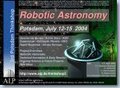
Robotic astronomy

3rd Thinkshop 2004
12. Juli 2004 – 14. Juli 2004

The aim of the meeting is to bring together astronomers and technicians from any field in astronomy to review the current status of robotic telescope projects and to discuss the future science cases for such installations. New results from existing robotic telescopes and their ongoing projects will be presented. Part of the "Thinkshop" concept is to jointly think about new scientific projects tailored to the unique capabilities of modern robotic telescopes, small and large.

Potsdam, Germany

3rd Helmholtz Institute Summer School - Chaos and Stability in Planetary Systems

1. September 2003 – 26. September 2003
thinkshop2.jpg

The Local Group as a cosmological training sample

2nd Thinkshop 2003
12. Juni 2003 – 15. Juni 2003

The Local Group (LG) is the astronomical environment we can study in most detail. As such it provides the ideal test bed for our ideas of the Universe at large. The goal of this workshop is to bring together experts in all aspects of the LG who are using observations or simulations of the Local Group to constrain models of the growth of structure and galaxy evolution.

Potsdam, Germany

2nd Helmholtz Institute Summer School - Scientific Supercomputing in Climate Research

28. August 2002 – 20. September 2009